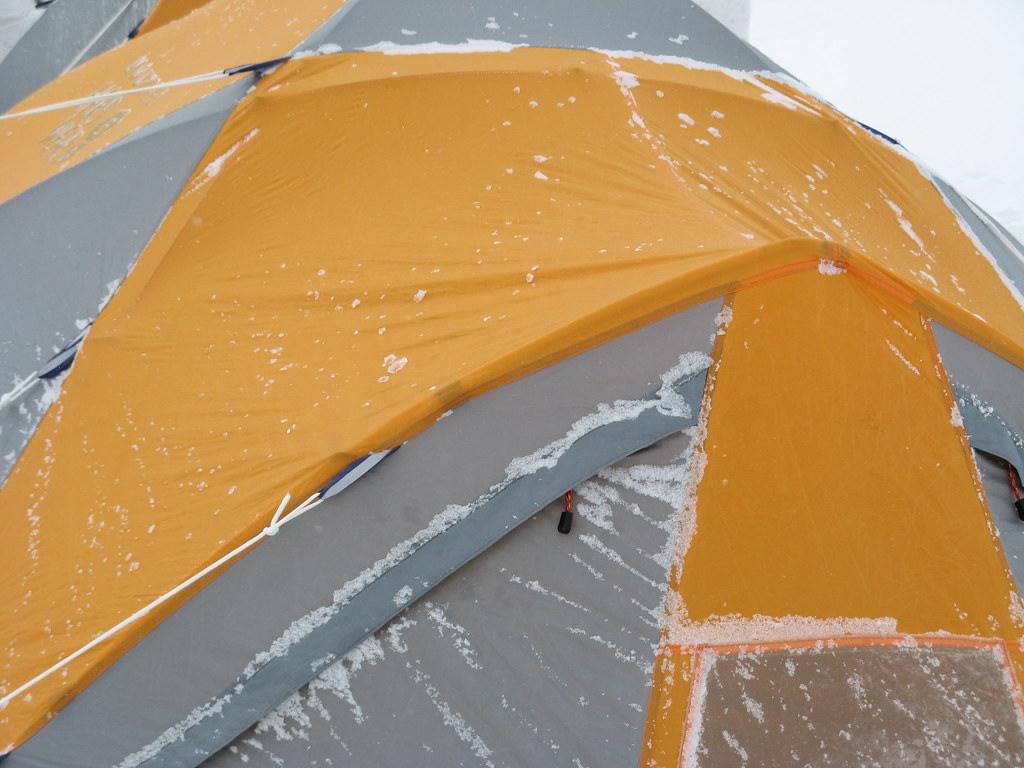
Thursday, August 4, 2011

Foraker 2011: Tuesday, May 3 – Carry to Camp 3 (Day 8)


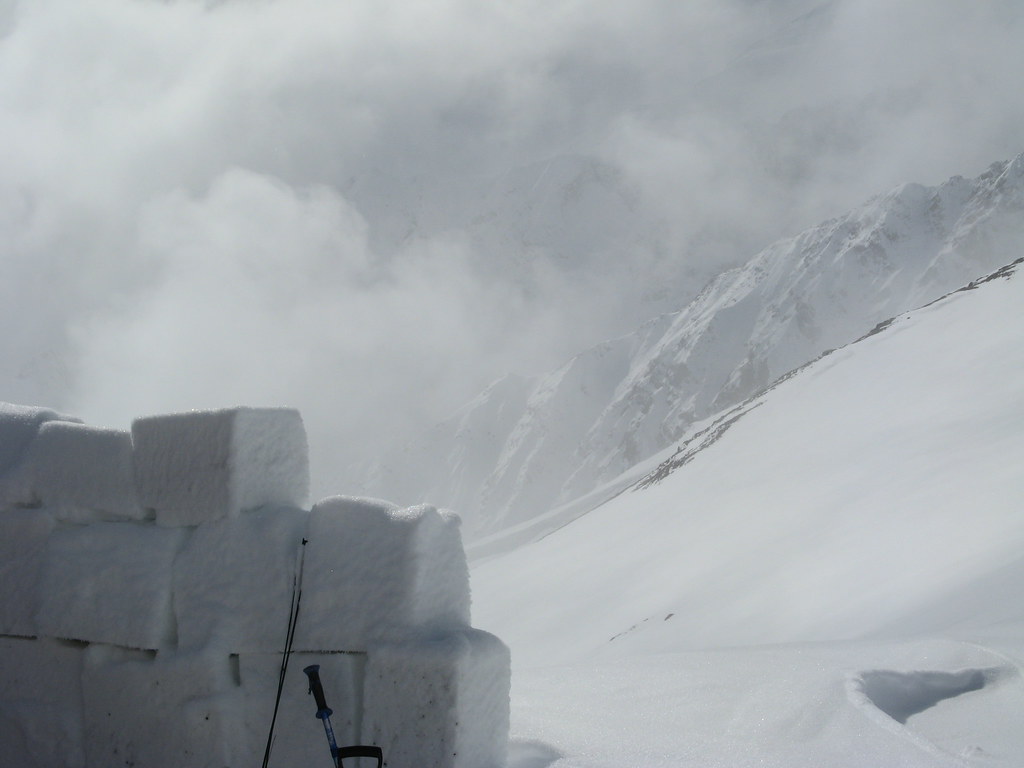
The wall that looms over Camp 2: better than coffee
Watch for links to video below, and click pictures for larger versions.

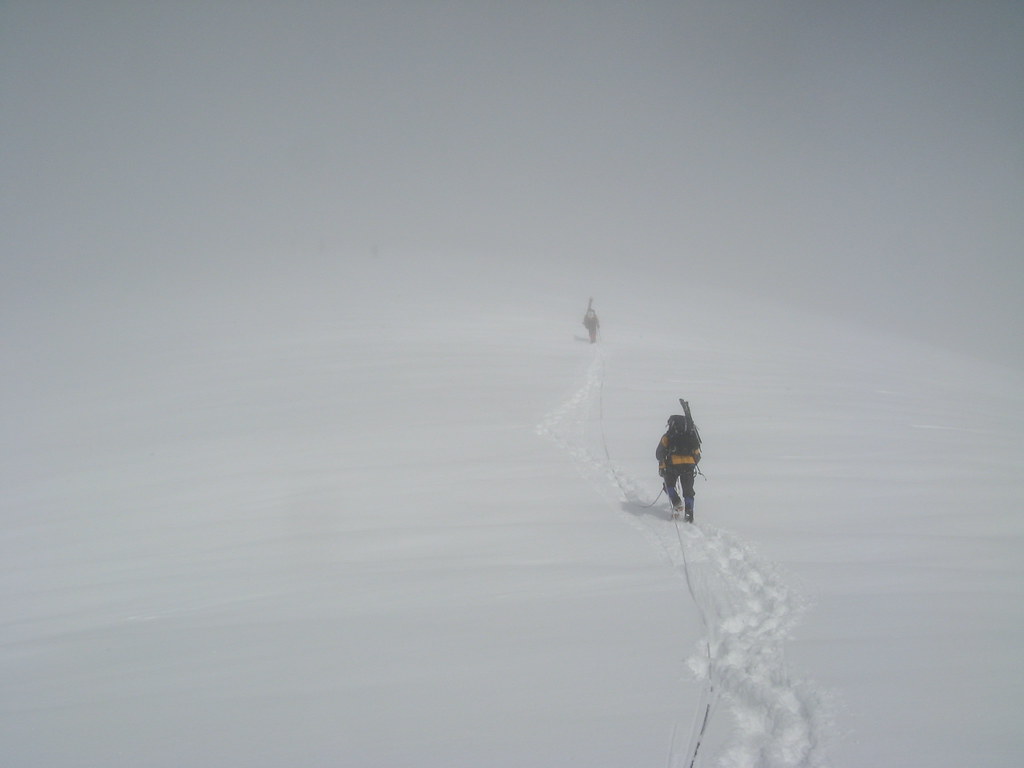
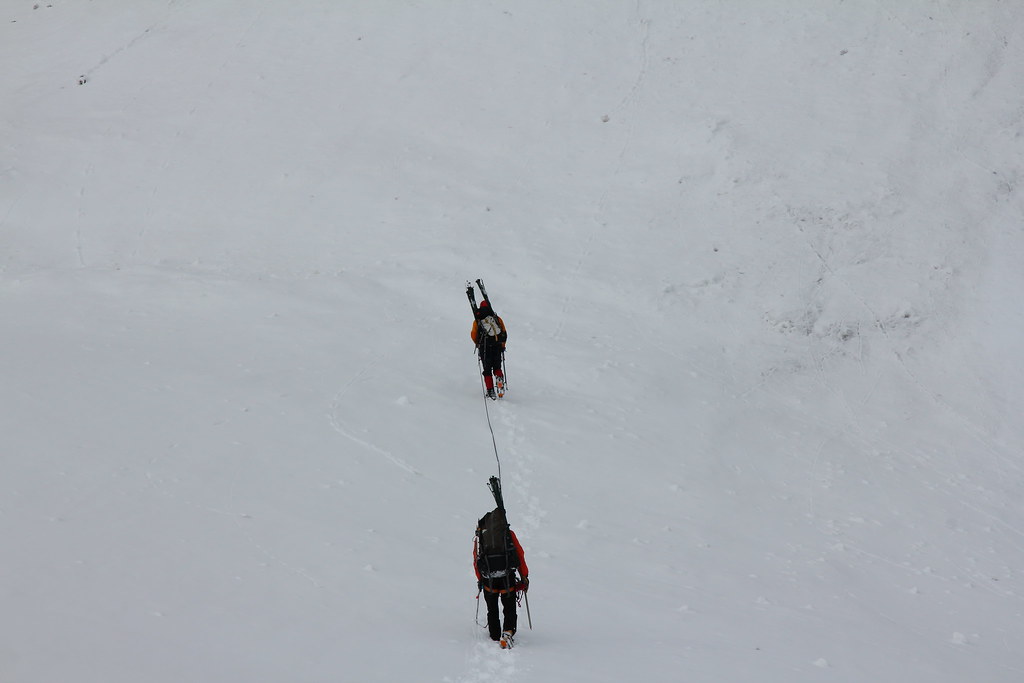
As I watched the length of rope between Nate and Craig—and then between Craig and me uncoil slowly, I listened as it hissed softly, rhythmically with every step they took, pulling through a foot of dry Alaskan powder and wondered what today would hold for us.

That sound, I find, is both soothing and ominous in the deafening silence of such a wilderness, and its portent is never known until you yourself start moving, too.

Mentally and physically, I was fired and fueled for what I knew would be a lot of hard work today, but to be honest, I still had a quiet, nagging concern after what I considered a weak performance on my part yesterday.

Craig and I stood near each other, clipped in, just waiting for the person in front of us to stretch out the rope. But for better or worse, watching he and Nate make their way out of camp and slowly upward ahead of me gave me plenty of time to ponder my ability to get through the coming days that certainly held more monster climb days.

And then it was my turn to start moving out and up as Craig stretched it out. Immediately above our camp loomed the first challenge: a 100-foot wall of rock and snow that progressed sharply from horizontal at camp to near 70 degrees at the top. Five minutes later, halfway up that wall, I wryly noted that all thoughts but those of focus on the task at hand had vanished from my head.

Those initial moments marching out of camp in the morning are always interesting for me. With your pack on again—seemingly just hours after dropping it in exhaustion the night before and starting out cold once more—they're the moments that seem to set the tone for the whole day; the moments you know you'll either push through the brain and body fog from the previous night's sleep and go like a machine, or note with perhaps a hint of worry that the fog isn't clearing as you search in vain for a rhythm that isn't coming.


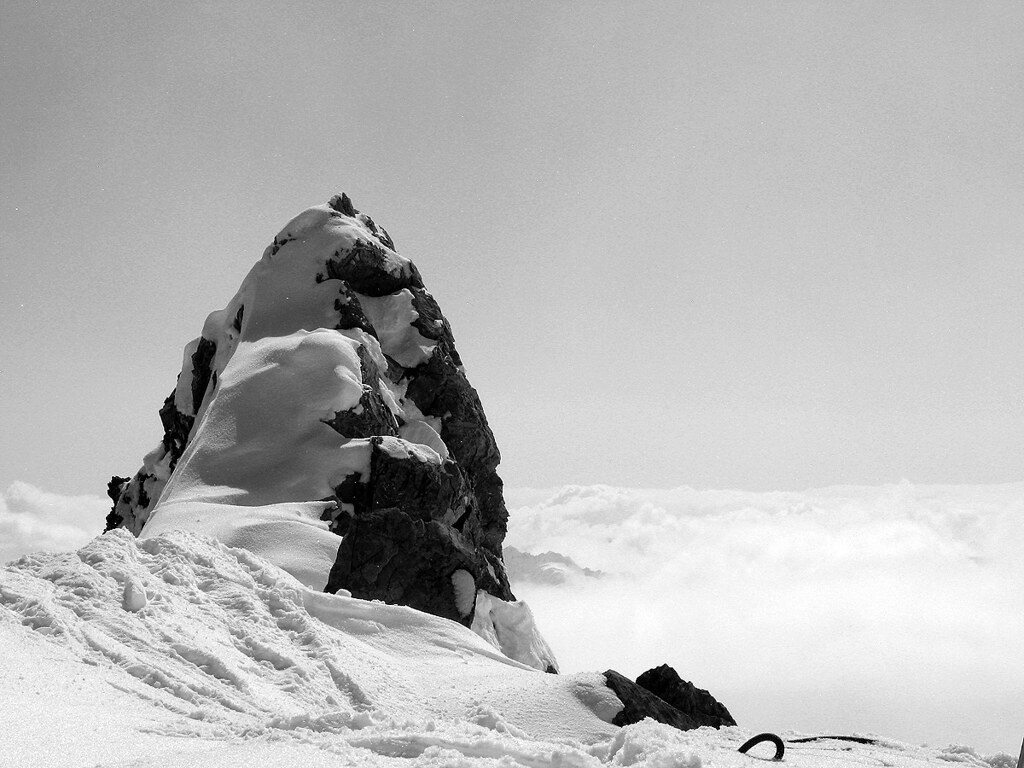
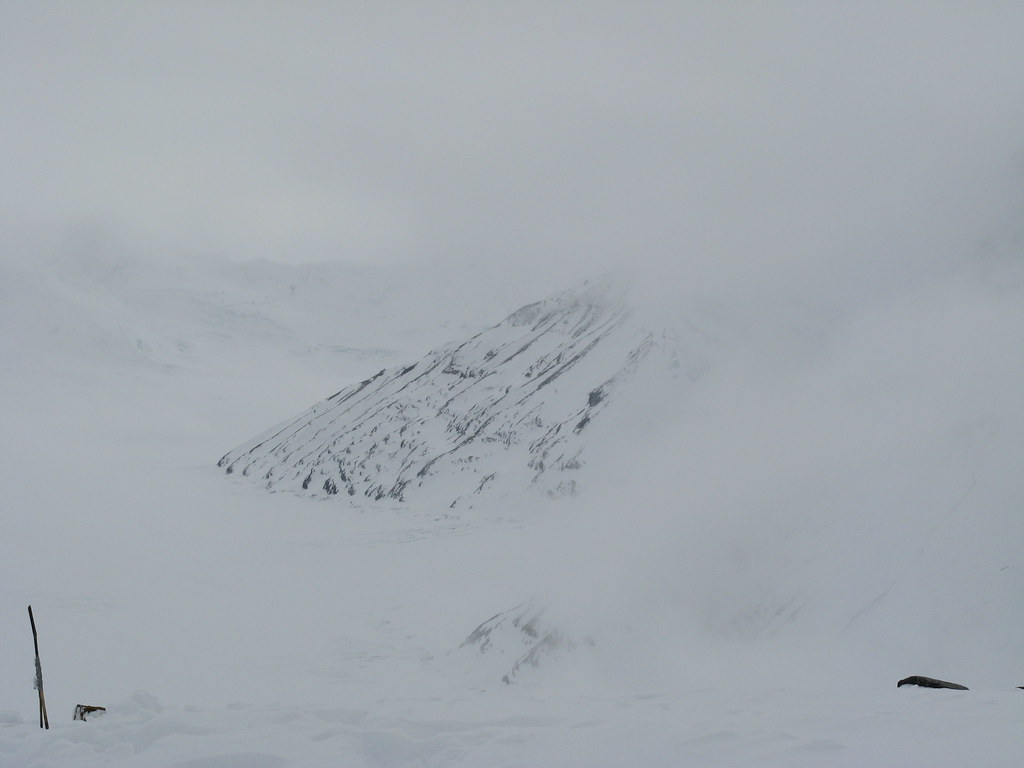
A view of the scorpion-tail of Mt. Hunter
 Today, I knew I was going to be fine. A huge bowl of good, slow burning oatmeal with cashews, yellow raisins, and cranberries pushed me up the steepest, longest, toughest terrain I've ever been on, ranging from chossy dirt and scree fields, to wind-hardened styrofoam snow; and from deep, soft powder blown by the wind to bullet hard glacier ice, always pushing ever upward.

Our rope team order has now been well established. Nate leads, Craig belays from the middle, and I carry large bunches of 4-foot willow wands and mark our route. My other two jobs are 1) to pull the protection pieces Nate has placed above as I pass them—ice screws, snow pickets, and other anchors—and 2) to place those same protections for my team behind me as I lead the rope team on the way down.

A few days ago, I was in this same role in the larger group's carry from Crosson base camp up the fixed lines to Camp 1, but I was asked to leave those anchors in place as I passed them because we'd need them there the next day to move camp up the route, too.
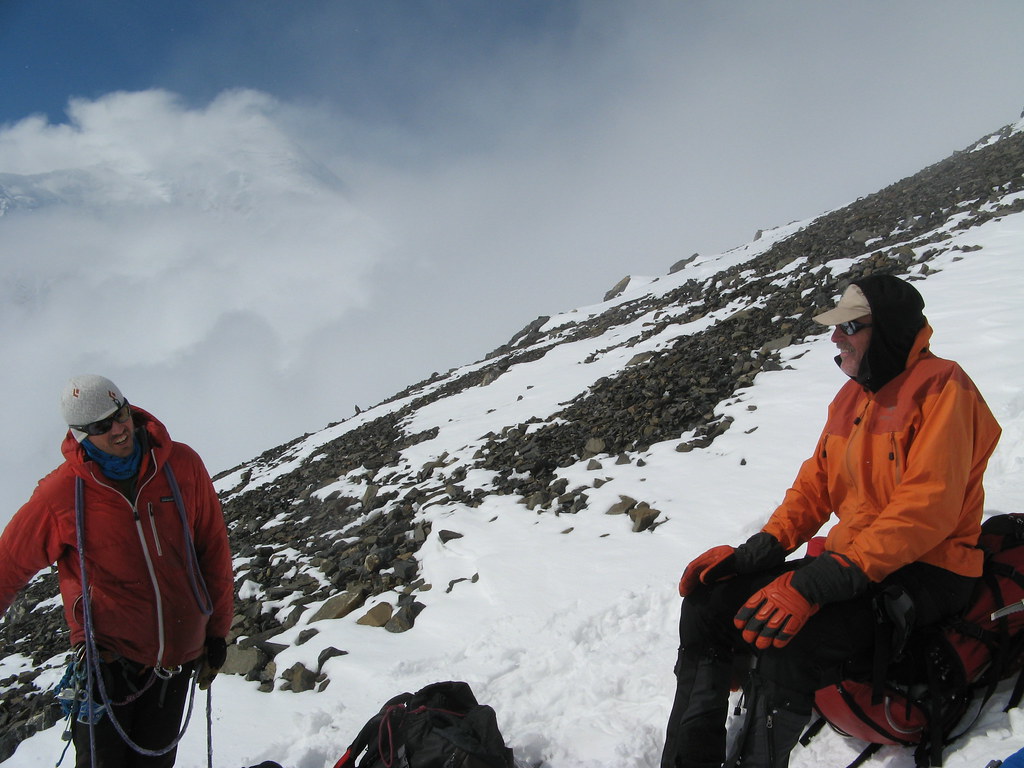
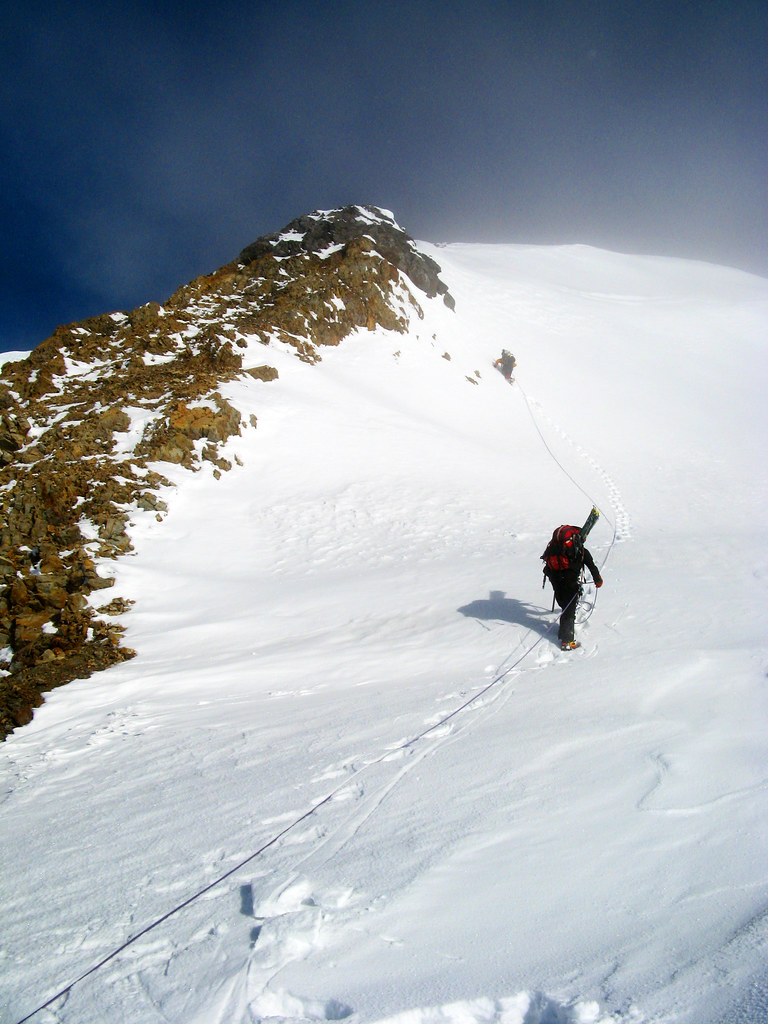
A bunch of wands sticking out of my pack on a break stop.
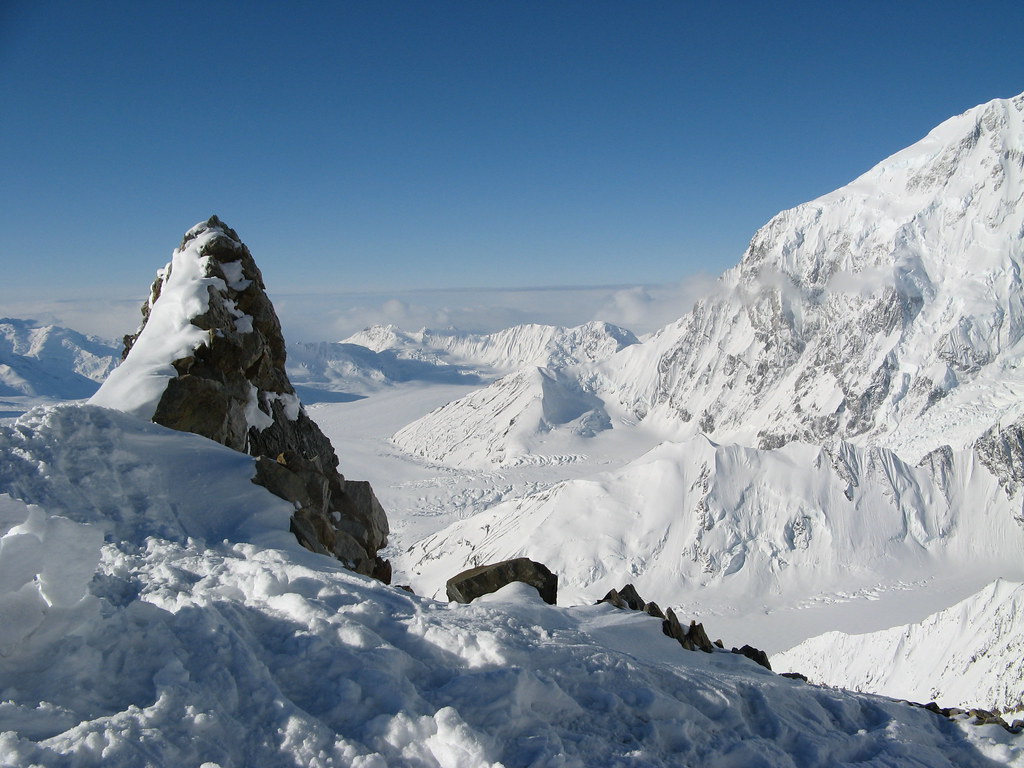
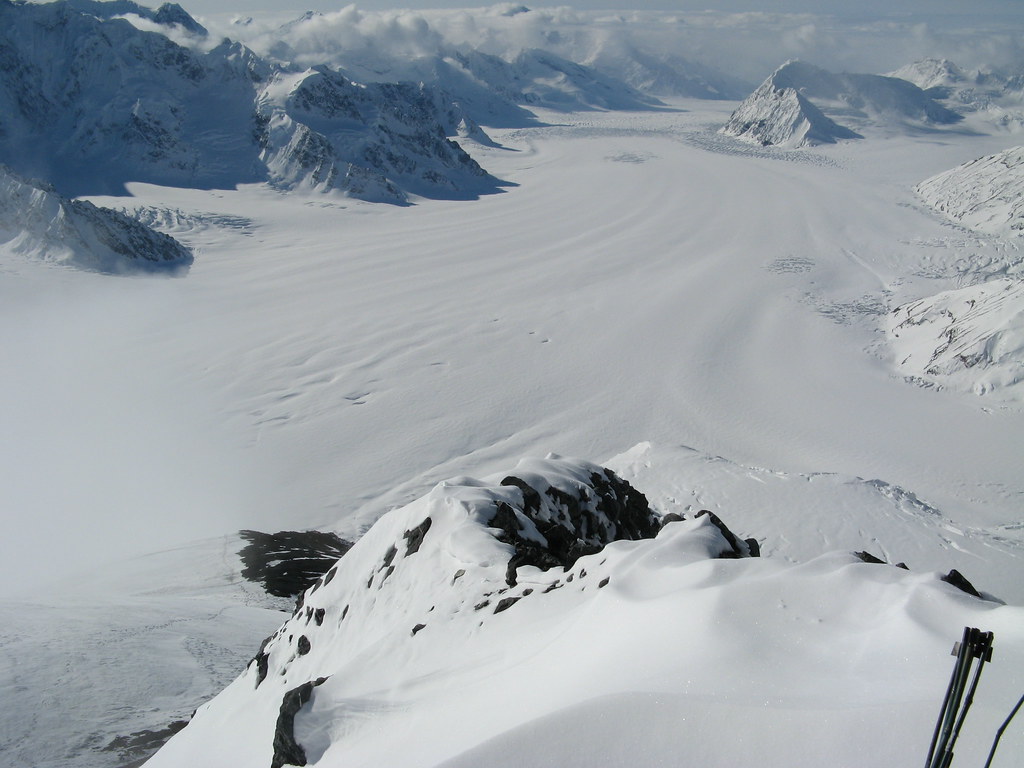
Oh yeah, and an INCREDIBLE view.
So today, we climbed. And climbed. I dutifully wanded the route, which is simply a task of placing a tall thin stick with little colored tape flag in the snow every rope length to act as a trail of breadcrumbs back to camp in case we get caught high on the mountain in unexpected fog or a snowblown white out.

But because today, like the other day, was just a carry and descent back to Camp 2, I followed what I thought was the correct protocol once more, and left all the pickets I passed right where they were in the snow, thinking logically based on yesterday, that we'd again need them tomorrow.

About 800 vertical feet up the route after some hard climbing, Nate stopped on a ledge and reeled us in on the rope, and then asked me for the pickets back. We hadn't explicitly discussed what I should be doing with them, but he assumed I'd been pulling them as I passed.

Stunned, I had to confess I'd left them all where they were on the way up. He was stunned, too. The problem was that the next sections of the climb above us were far steeper, of much higher-consequence and covered terrain that was significantly more exposed than we'd been on so far, and he needed every anchor we had to protect it.


A bunch of F-bombs ensued from both of us, and I felt soooo stupid… but after the shock of the predicament I'd put us in wore off, we started talking more seriously about real options. One suggestion was that we could just make it a mellow day today and cache the food and fuel we were carrying near where we stood instead of up high, and limit ourselves to just an 800 foot gain today—and then climb high tomorrow with maybe an extra back carry to retrieve the stuff.

One thing was certain, however: continuing upward with only the one picket and one ice screw was not an option, Nate said. We would need every piece we had to get up the next several sections, because it presented such serious exposure with just one slip.
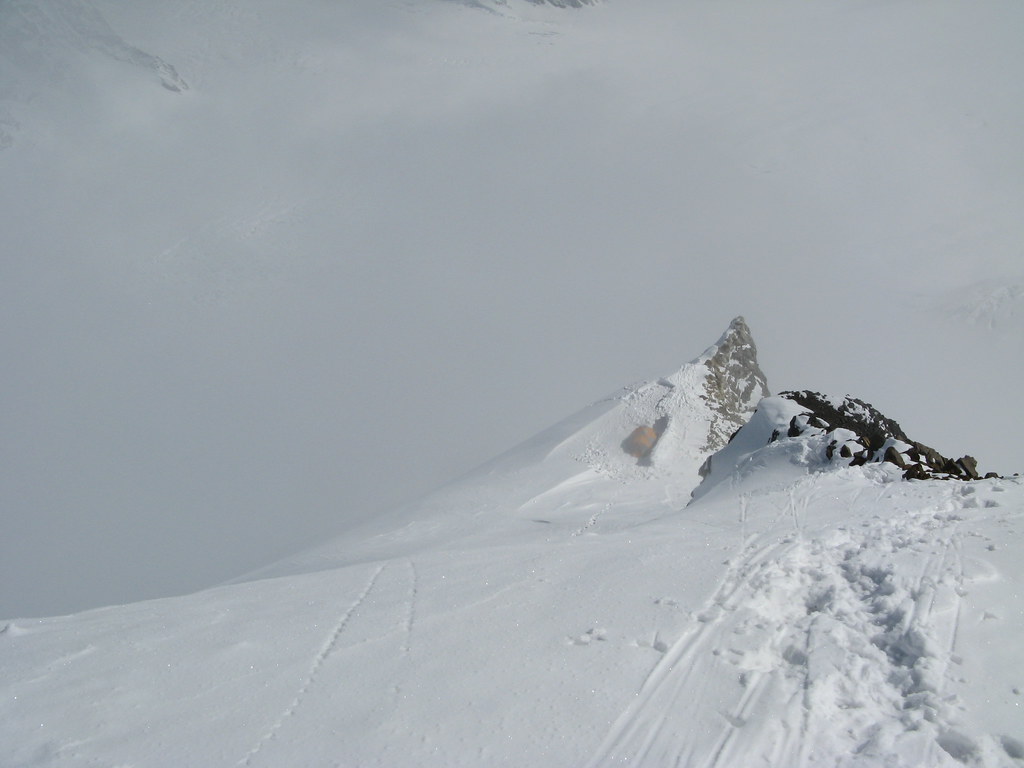
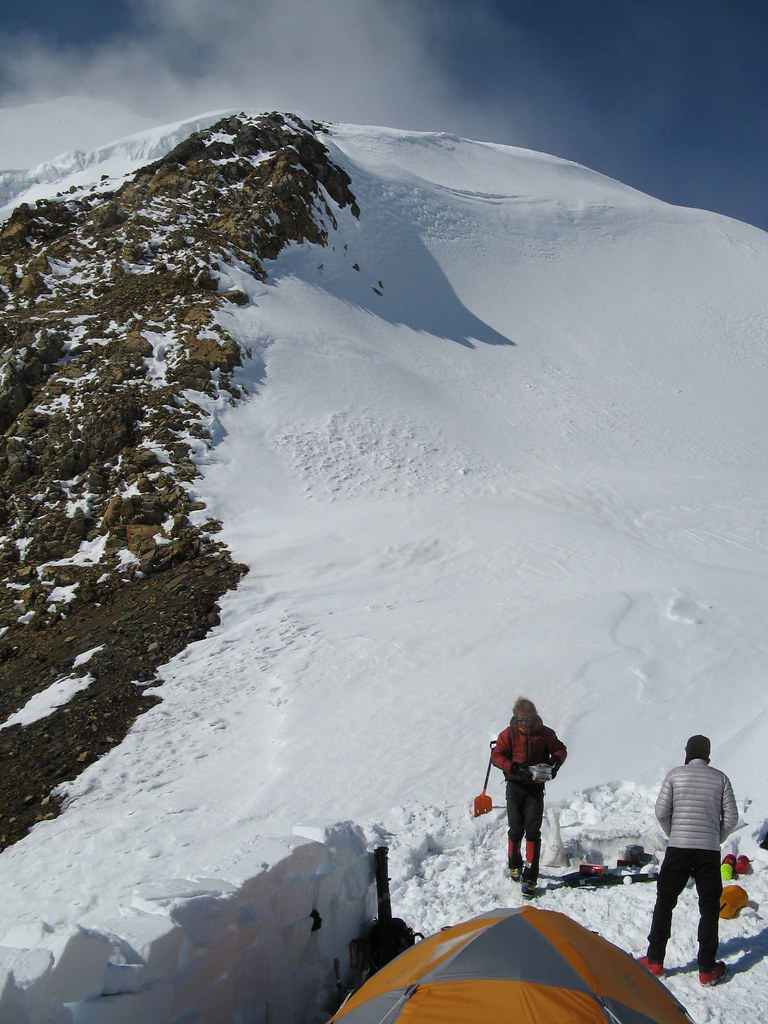
Camp 2 from high on the ridge above. Check out the tent and wind wall.
After we got our composure back and had a bunch of back and forth to try and solve the problem, and, I suggested we drop packs where we stood, I stay on rope and descend the last big ridge we now stood on top of, and go retrieve at least the two pickets placed on the slope below us—and then we could continue on up.

Throughout this exchange, I was mentally kicking myself so hard, and I apologized profusely for the error. I should have asked explicitly if I needed to pull them all, but Nate said he's shared the blame for not being specific, especially having left them behind intentionally the other day.

There was more debate, but ultimately my suggestion was the solution. So I ruefully dropped my pack, got back on the rope, and down climbed 150 or so vertical feet of the last slope eagerly to try and make up for my stupidity. I pulled the pickets placed there, and the re-climbed up to our stopping point.

Nate then give us careful instructions for the next sections on up to the top of the mountain. "Be very, very surefooted with every step." And we were.

When we started climbing again, we were armed with five anchor pieces instead of just three pickets and one screw. Nate cleverly used his second ice axe as another anchor too. Neat!
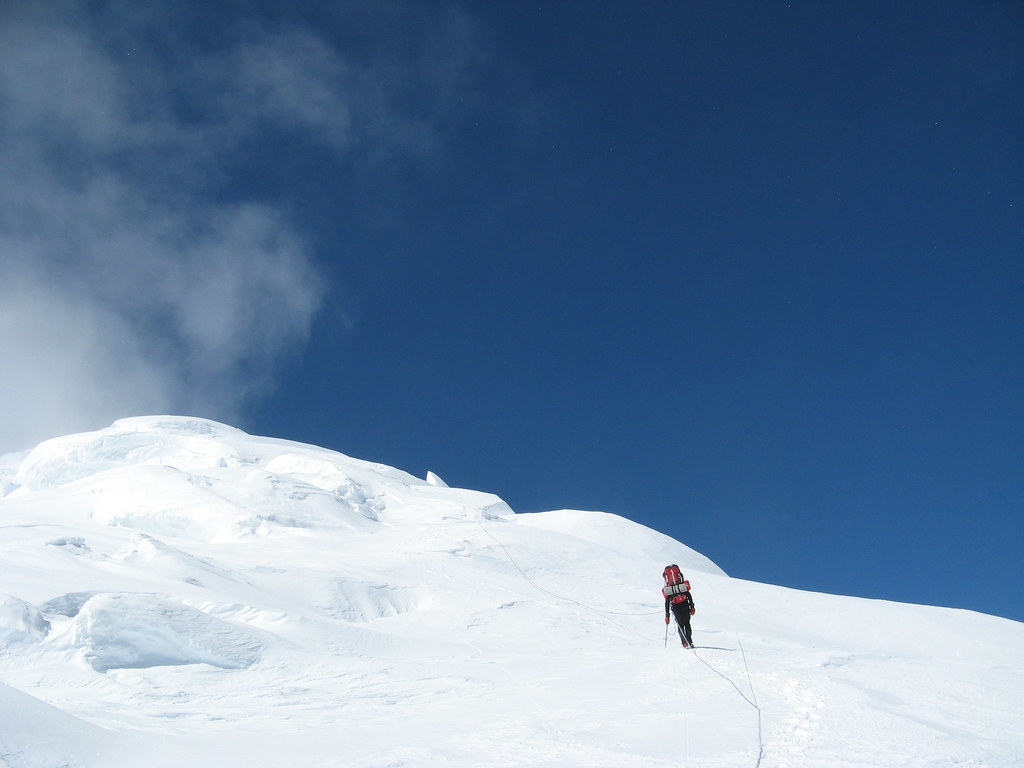

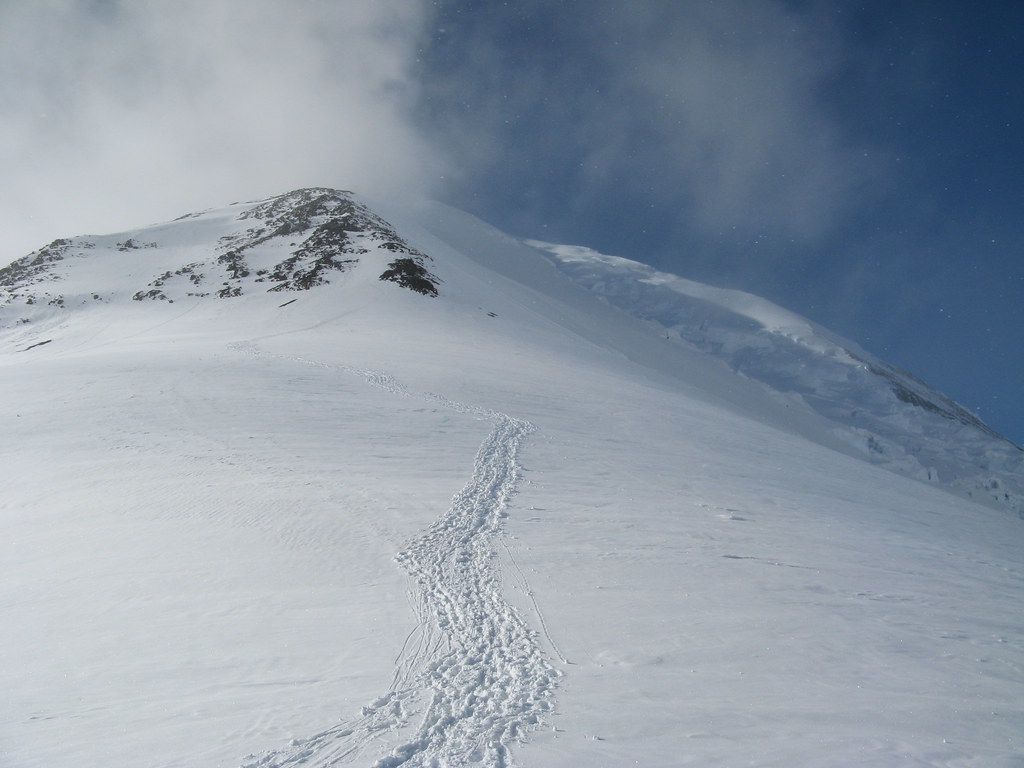
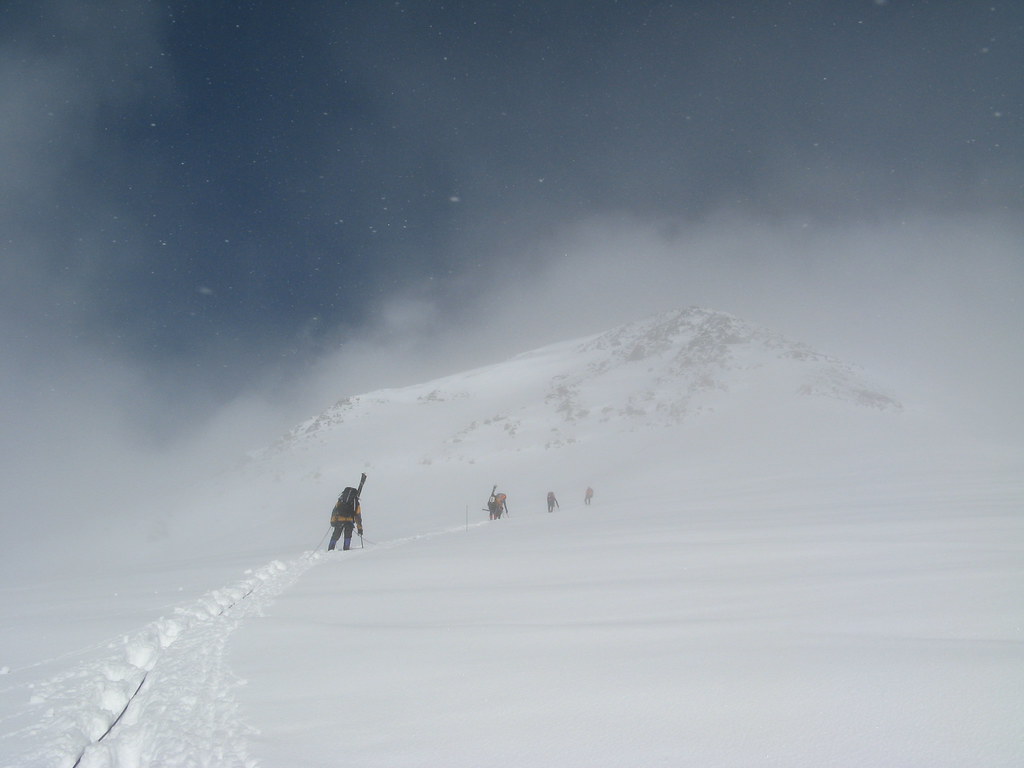
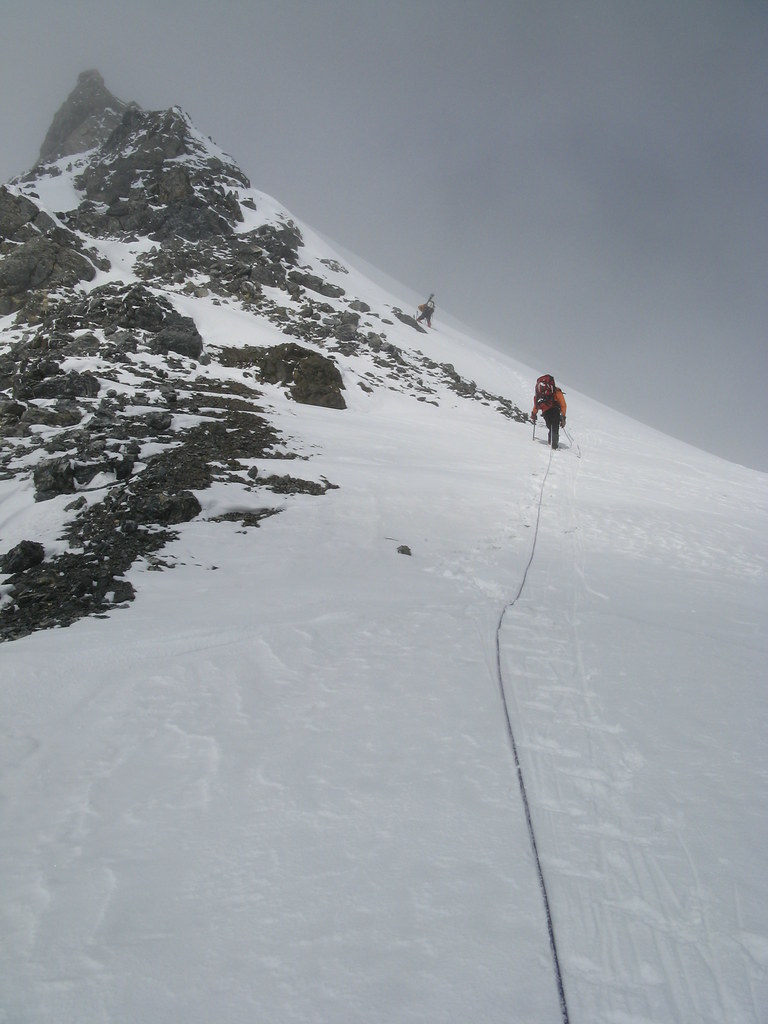
Climbing... and climbing on Crosson
 So on up we went, carefully stepping over open crevasses, walking hard ice and snow bridges on vast sheets of windswept snow and ice crust. In most places, our crampons and axes bit, but didn't sink, and they squeaked in protest, singing at dissonant icy tune with every step—and the wind had picked up.
 

Finally, with only about 500 vertical feet to the summit of Crosson, Craig said he thought he might be out of gas, and that he'd been feeling out of breath and was having a hard day—kind of like me two days ago. Having been in that same condition recently, I empathized, and we again discussed options.

We decided to cache the gear there and pick some more food and fuel up tomorrow as we passed through, so Nate scouted a spot for the cache hole and started chipping away laboriously with his ice axe adze at the near-rock-hard wind scoured snow, alternately chipping, and then shoveling it out.

We were standing on a huge, open flat area beneath what looked like giant snow blooms and graceful blue ice overhangs carved by the unceasing (and now howling) wind. Our stopping point was beautiful, but the wind had continually cranked up the higher we went, and it was bitterly cold.
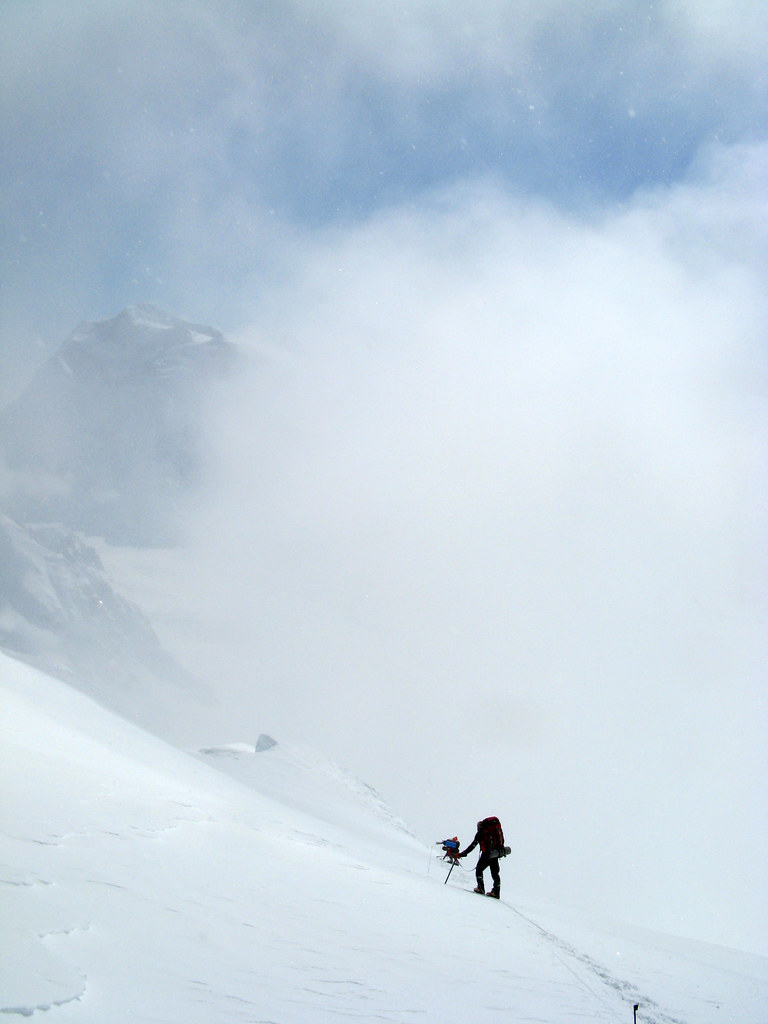

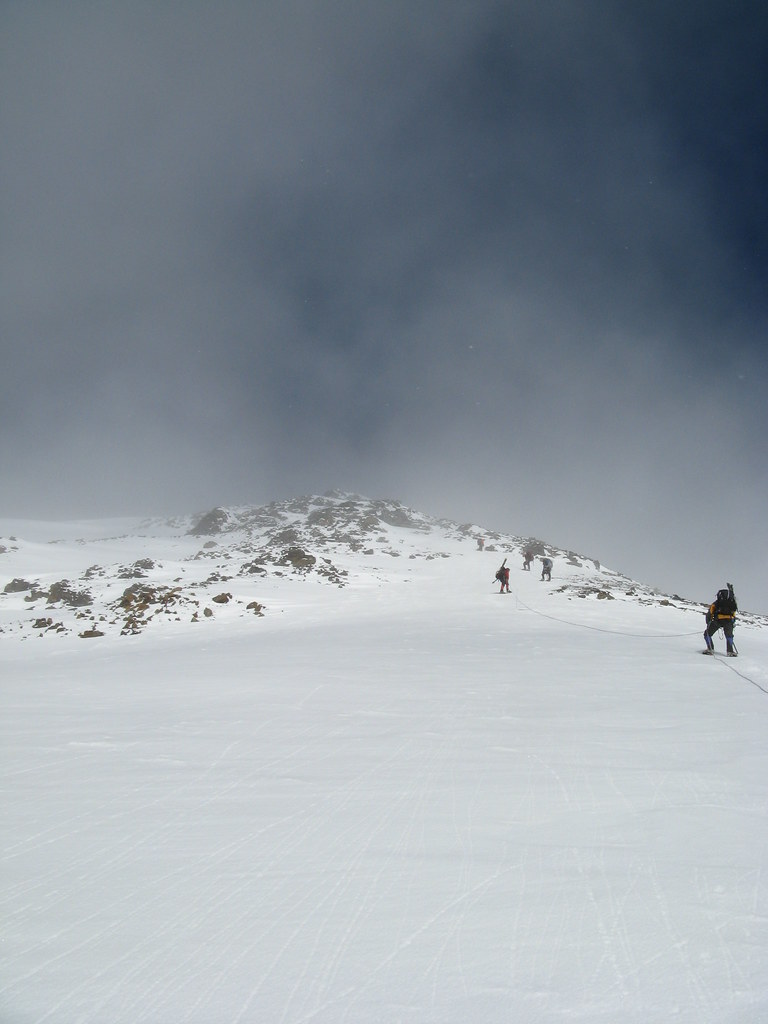
The downclimb - rock-hard snow and a 3,000 foot drop to the glacier on our right.
Don't slip.
Pulling in to a spot like that after climbing hard and being all sweaty, one hesitates to put one's pack down, because it's keeping half your body warm. But I didn't want to see Nate chop that hole out all by himself, and it also gave me a way to stay warm the same time.
 So we alternated chopping and shoveling for a bit, but the snow was so hard, it nearly took us nearly an hour and get a hole that was probably still too small for all the stuff we wanted to put in it.

After more work, we'd finally gotten close to the size we needed it to be in the hard, hard snow, but in the last few strokes before we were to start filling it with group food, wands, and extra fuel, the adze of Nate's ice ax head snapped and whickered off into in the snow. It was destined to be a swearing kind of day, it seemed.

Several groups food bags, gallon cans of fuel, large bunches of wands that we will need up higher on the route, sacks of personal lunch food to last each person 8 days, plus all our huge puffy pants and jackets all went in the hole.

On the way up, my toes had gone cold—really cold—long ago, and I was concerned. When that happens, you can only do what you can do to keep the circulation flowing, because taking off your boots is not an option.

So there I stood, temperature dropping, wind howling, trying to fend off the deep, penetrating shivers that seemed to stab through every fiber of my puffy jacket with my toes damn near frozen. I began to stomp my feet, shake my arms and legs, and in doing so, I quickly came to understand just how quickly someone can get frostbite in a place like this (and we were only at around 12,300 feet).


Digging a hole at the cache site

The subarctic is no place for the unprepared. I pulled my face farther and farther back into my multiple hoods and tried to hide behind my face protection to beat back the viciously cold winds, but my softshell pants and jacket, R1 hoody, wool base layer, and hooded puffy jacket were only just barely up to the task.

And in spite of my efforts, I could feel my toes going colder by the minute; but there was no sign of us getting moving for a bit. We still had to fill and mark the hole so we could find it tomorrow, and reset the rope for the long downclimb back to Camp 2.

It was in that moment that I began to worry about the condition of my toes in earnest, especially my left big toe, though all of them were pretty numb, so while we finished up, I alternately swung my legs and arms furiously to try and force blood down into my feet and hands. I had limited success, but some success is better than none.

I changed my tactics to scrunching my toes over and over in my boots to try and create a little friction in there—but again, with limited success. I began wishing for the huge puffy gear we had just buried in the hole, because the wind had picked up even further—but at last it was finally time to go.
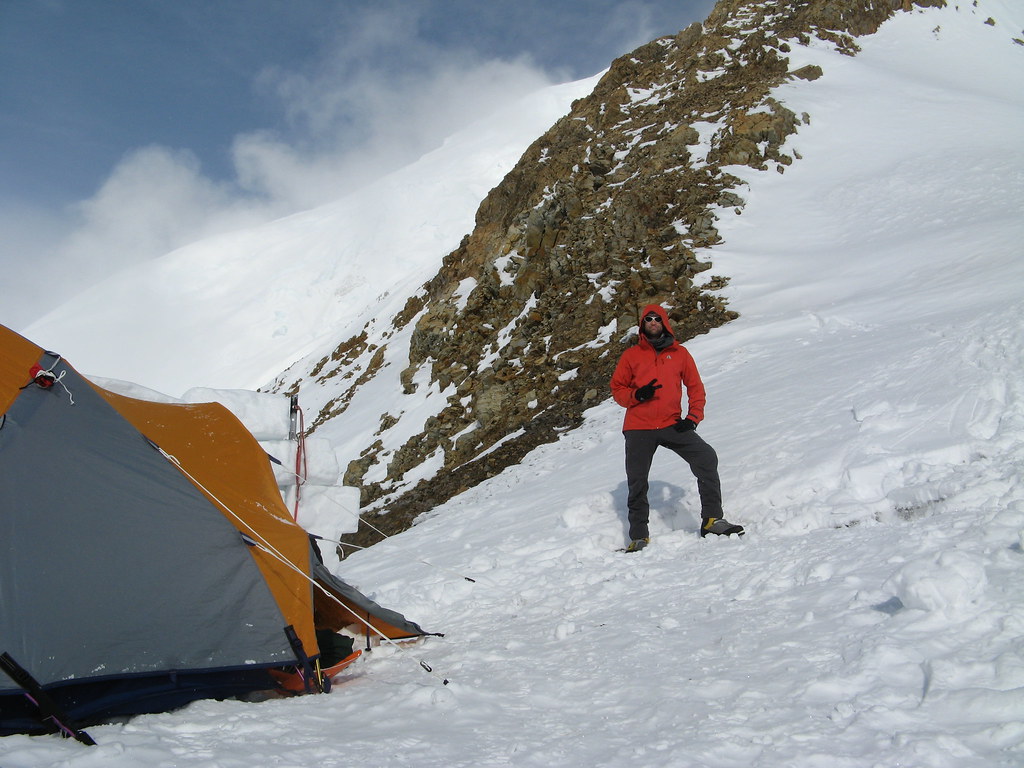
Nate had gotten everything buried, and he told me I'd be leading and placing protection on the way down, handed me what gear he had, reminded us once again about the importance of being surefooted on the descent, and off we went.

I took it slow at first, but soon became more confident and rhythmic, banging in pickets where protection from falls was needed on the steepest and most exposed sections. It took us a couple of hours to get back to camp.

 
Almost immediately below our top-out point, we walked back into the protection of the ridge and the winds started to subside, and I was glad to be into lesser cold as we downclimbed the route we'd just ascended.

We'd drop sharply—60° - 70° off ridge after ridge, outcrop after outcrop, until finally camp appeared below us. I was exhausted. While Nate fired up the stove and began cooking a huge, filling, and awesome meal of Thai chicken and rice in spicy yellow Curry, complete with rehydrated powdered coconut milk (yum!), I sat in the tent vestibule and pulled off my boots, scared of what I would see when I got them off.

My toes were all pretty much in complete whiteout, but the big toes were definitely the worst. Nate asked me to test the capillary refill of them by squeezing them, and those results were not encouraging, but I started massaging my feet vigorously and continuously to get the blood flowing again.

After about 15 minutes of this, I became concerned that I was frostnipped… after 25 minutes, I was sure of it, but FINALLY after about 30 minutes, the feeling started coming back into the big toes, and the screaming barfies started… a good sign that I might be ok. Whew! Scary.

 
I'm gonna have to take a look at the combination of my boot liners, socks, footbeds, and other things to see if there's something that can be done to improve the circulation. If this is what happens to them at 12,300, imagine what 17,400 on top of Foraker will do to them, should we get there. Yikes.
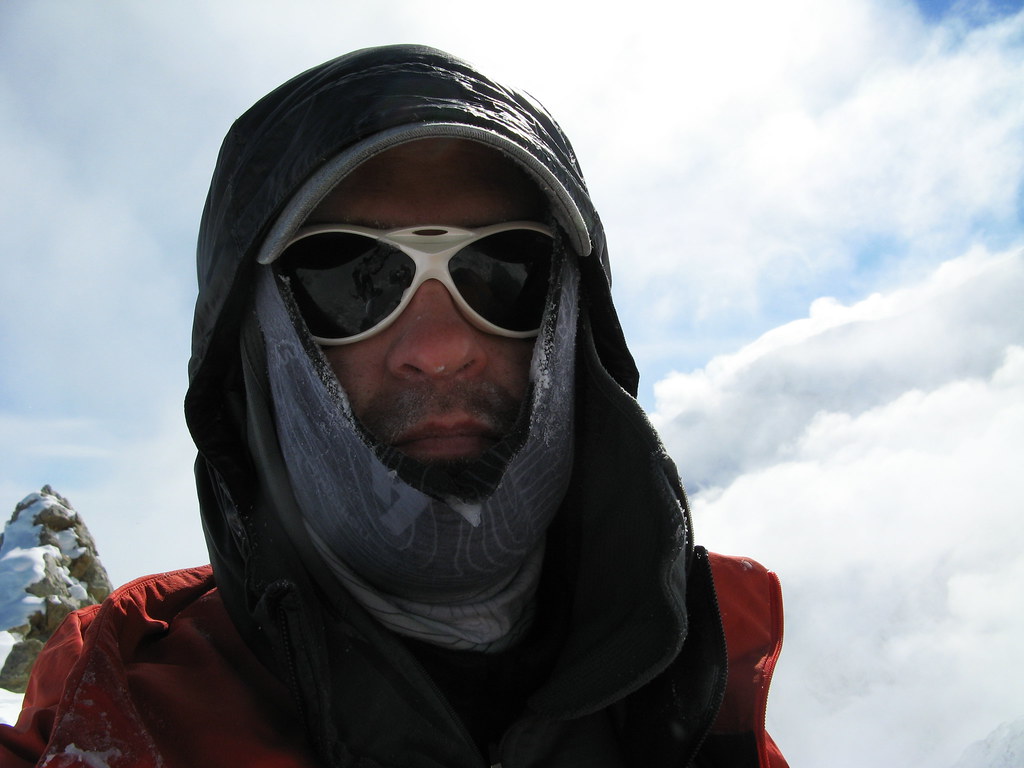

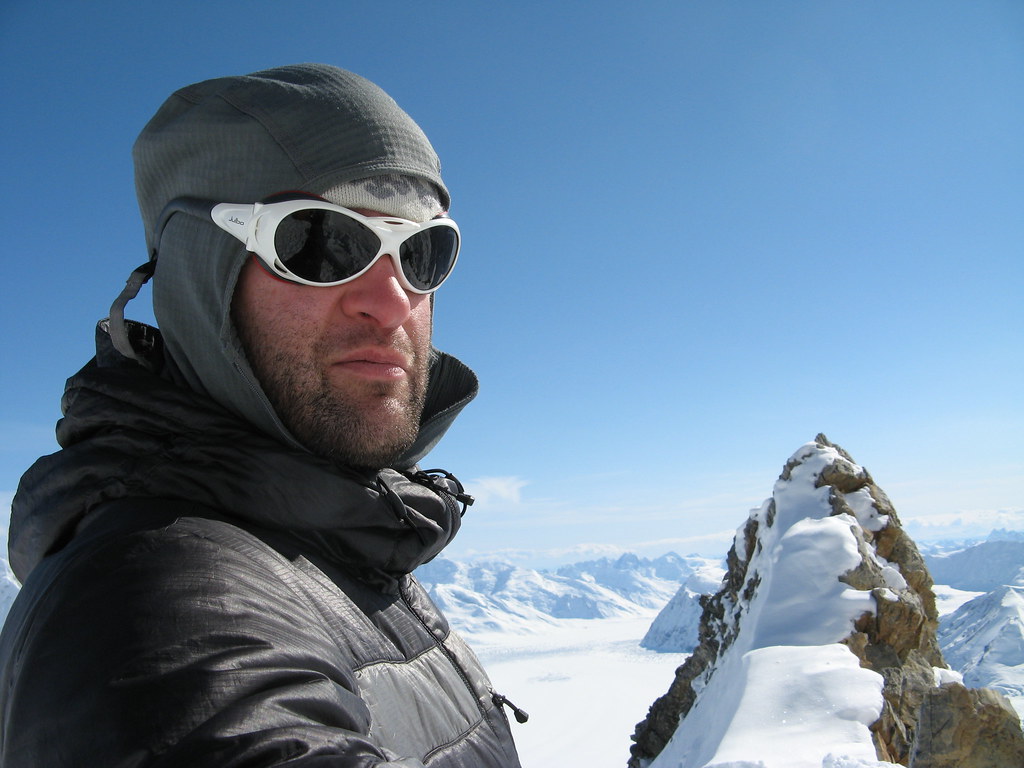
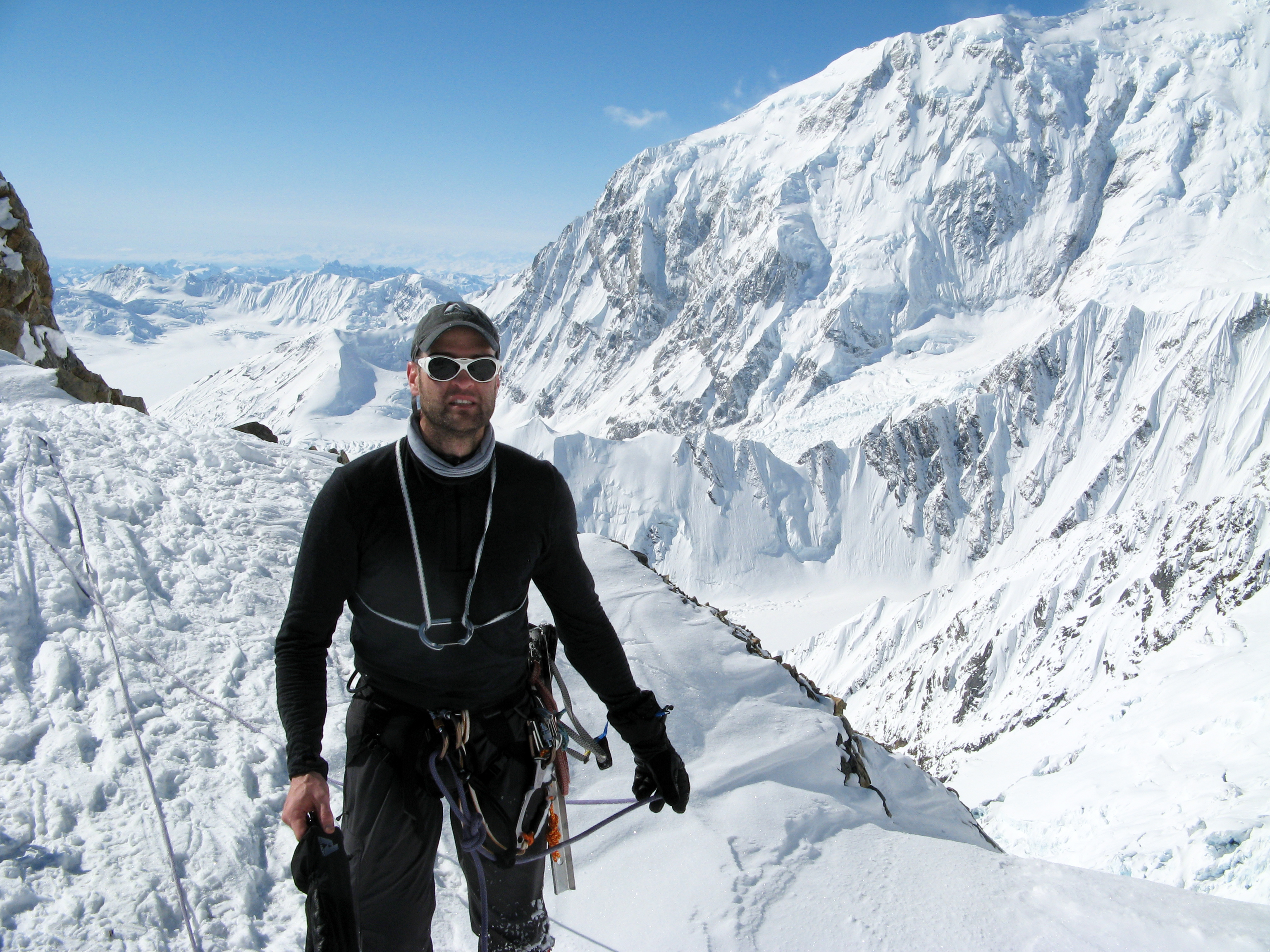
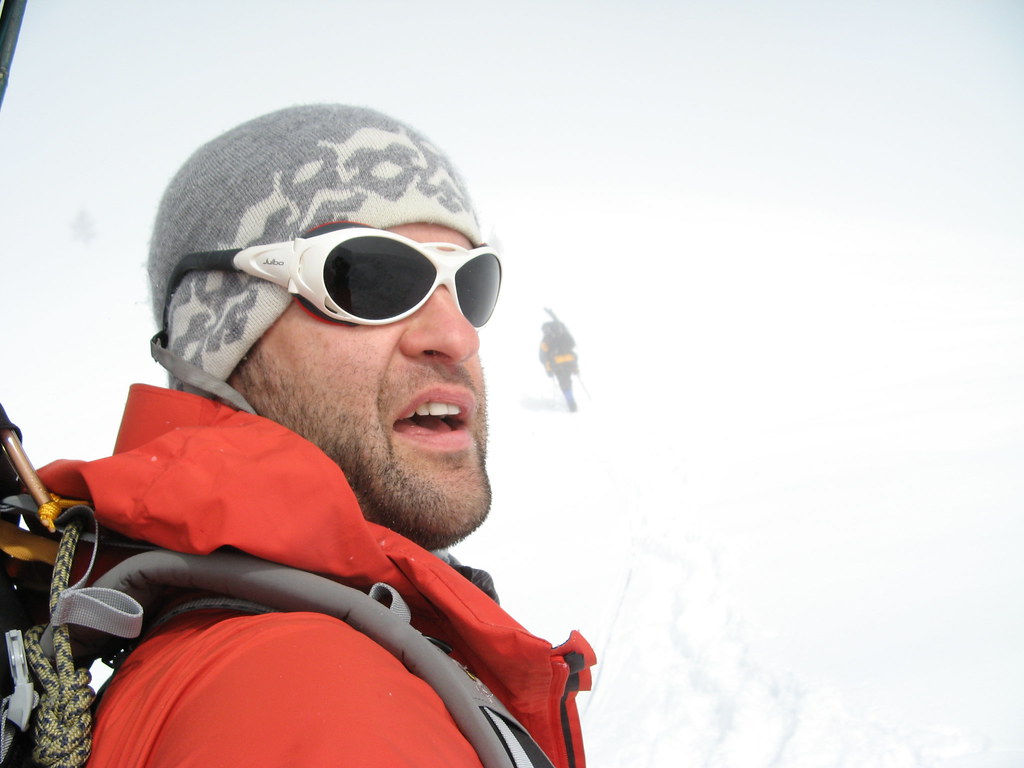
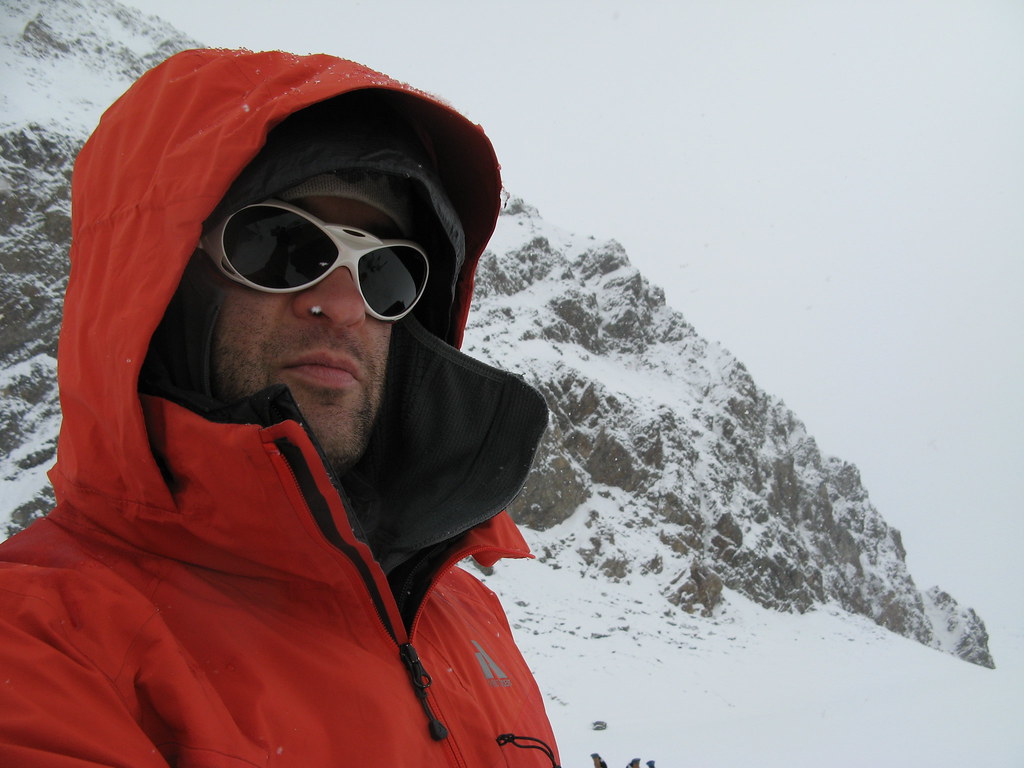
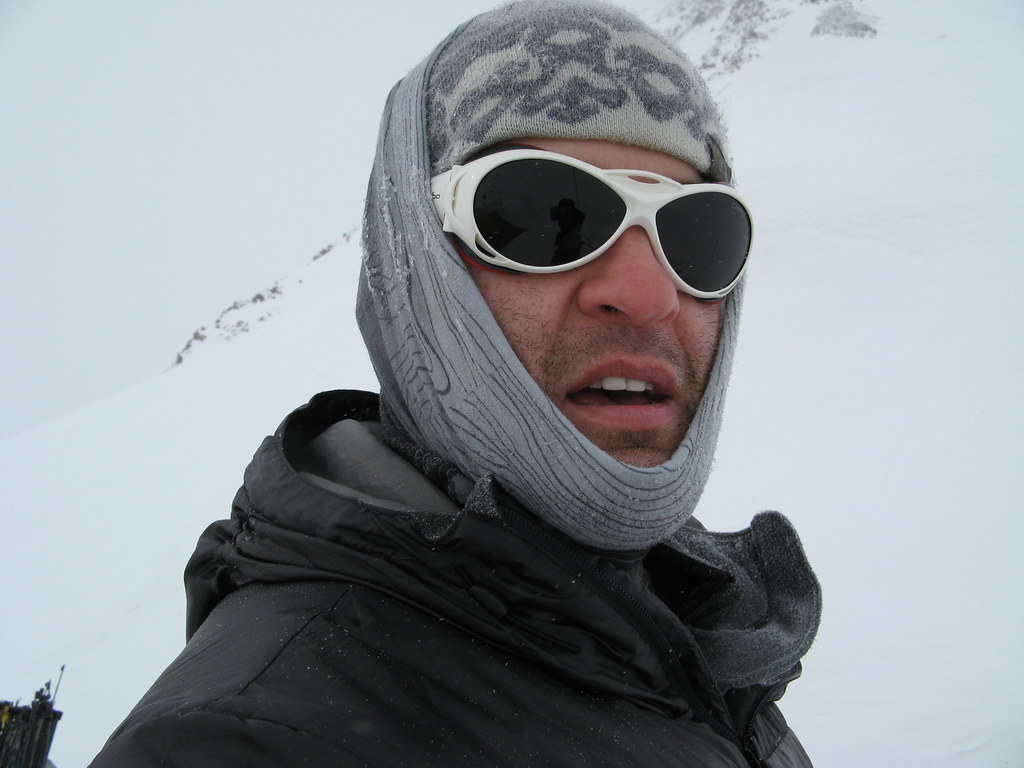
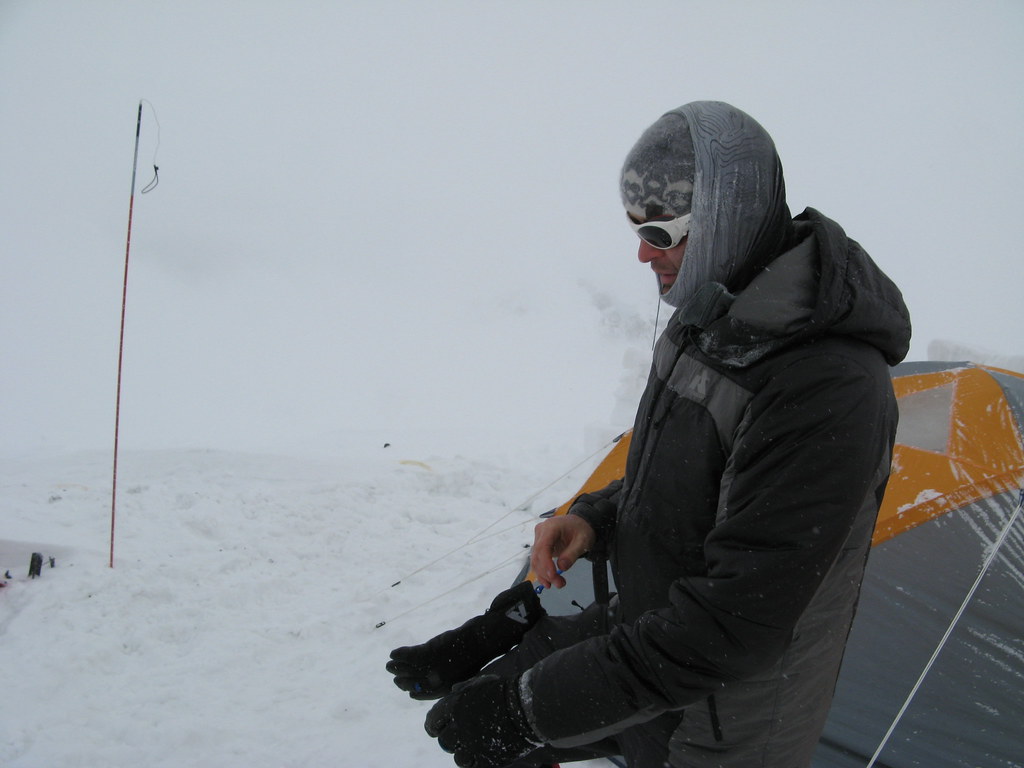
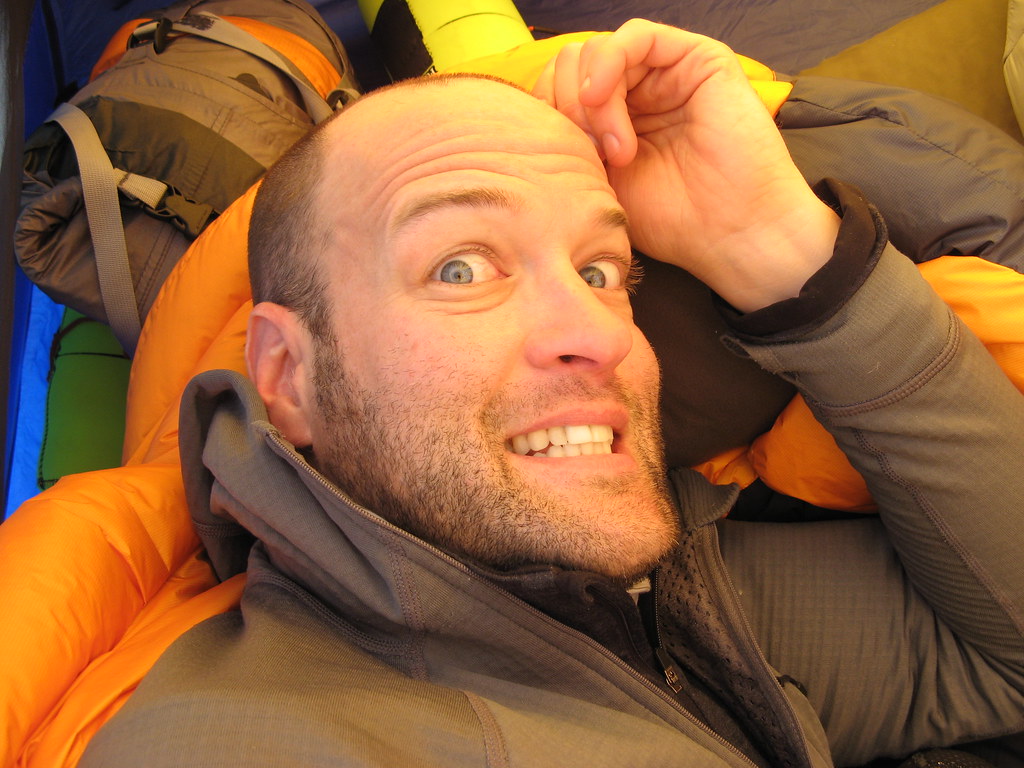
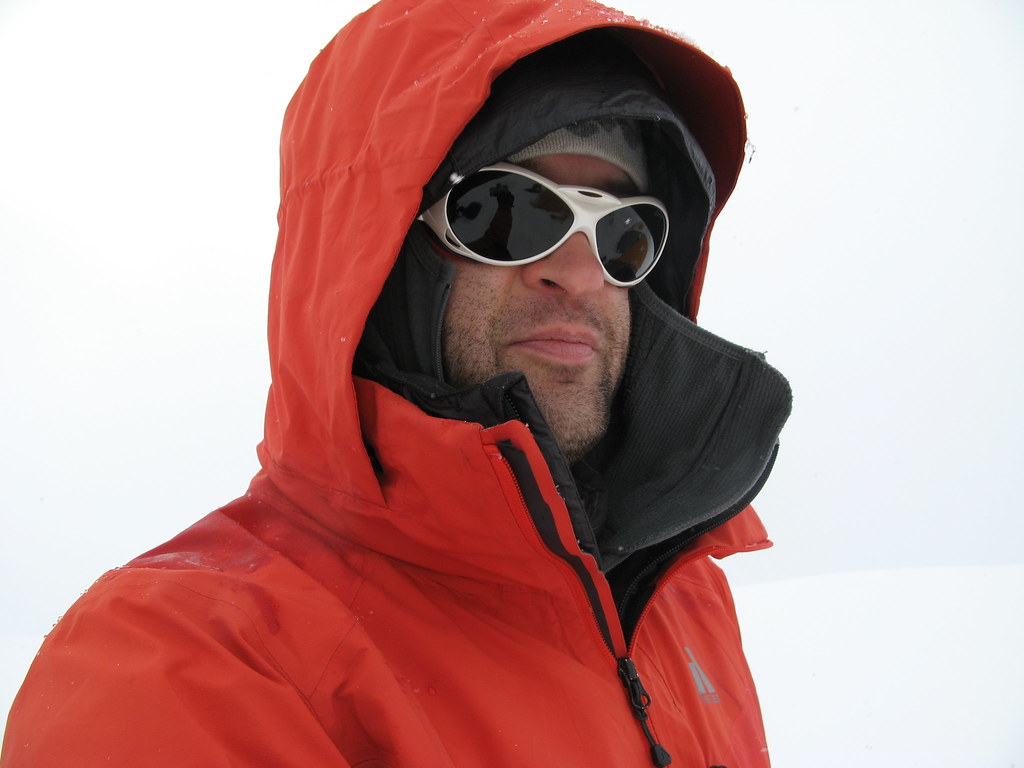
Me... after returning to Camp 2

Dinner was a delicious, hot, spicy, sweet, and savory meal that was much needed, and a perfect way to refuel after a hard, cold day of climbing. Then came the hot tea to warm the frozen bones. I soooo needed that.

As it stands, we're planning to move camp up tomorrow, by the same route, and establish a new camp there, or go all the way to the summit, 500 vertical feet above the cache point today, and then maybe do a short back carry to go get the stuff we stashed today.

It all depends on the weather, though. The weather report that crackled over the radio from the NPS sounded non-promising, though. Nate called in to AMS to double check with Rob Gowler and to get his take on tomorrow's weather. It's still uncertain, he said. I guess we'll know when we poke our heads out our tent in the morning.

I'm pretty proud of my performance today, though. Leading on the way down was a new experience, and found me frequently banging in pickets or twisting in ice screws and clipping in. We had all found a really nice rhythm together in both directions, and today, I was exposed to a surge of experiences that have forever changed me.


We'll see what tomorrow holds.
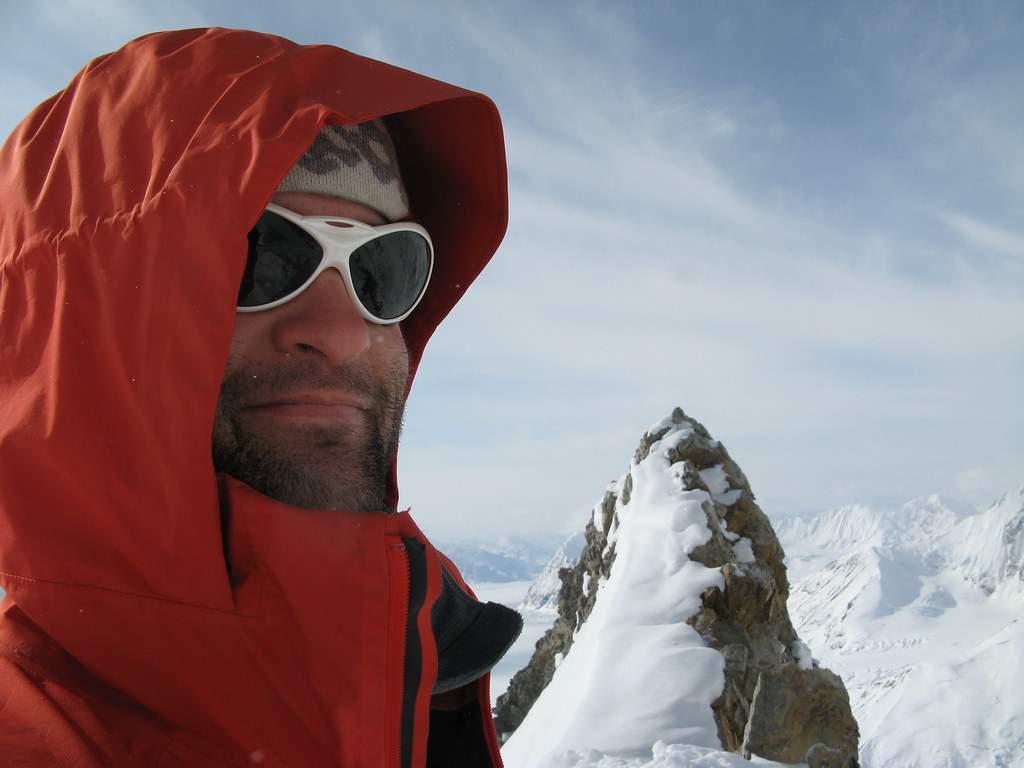


Monday, May 2, 2011

Foraker 2011: Monday, May 2 – Camp 1 to Camp 2 (Day 7)

Watch for links to video below, and click pictures for larger versions.
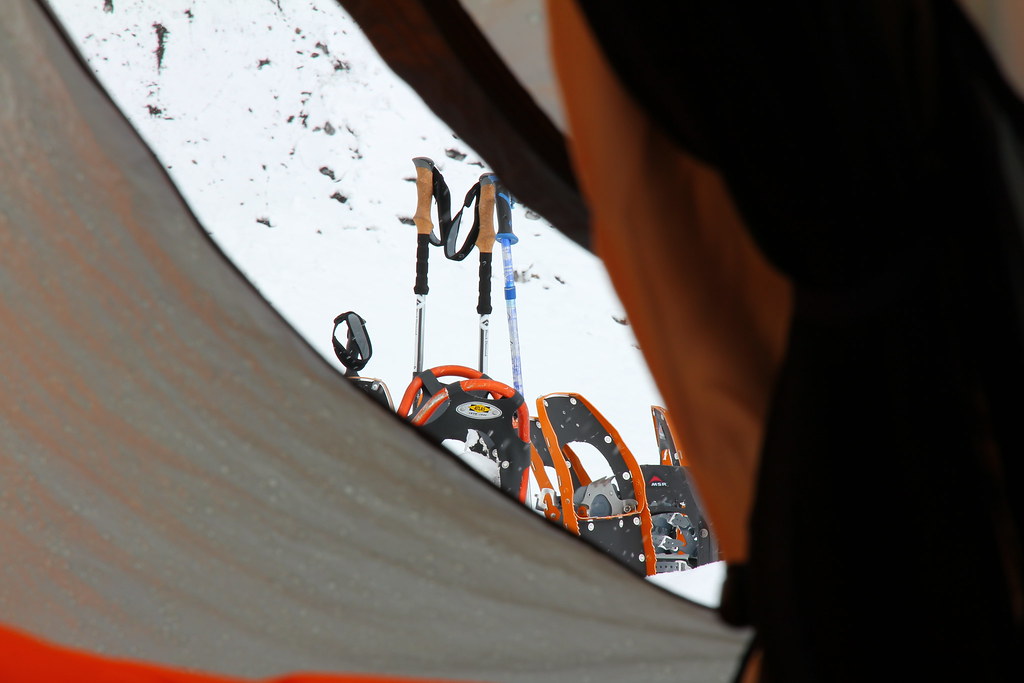

Wind wall at Camp 1
8pm - This morning, Joey, Bob, and Kirk saddled up to head down toward the glacier floor far below, and marched out of camp. Nate, Craig, and I would go the other direction later, but despite the carry of half our gear up to Camp 2 where we cached it yesterday, today's pack with the other half of the gear was still alarmingly heavy.
But where yesterday the three of us had powered up to Camp 2 with plenty of energy, today's climb of the same route was a grueling torture festival.

As I write this, I'm laying here in my puffy warm down sleeping bag, reflecting on what has been without question the single most physically demanding day of my life. Right out of camp, I wasn't feeling my normal strong climbing self. I just couldn't find my rhythm, and I couldn't figure out why I was so out of breath so quickly, when yesterday, I had destroyed the same climb. (I later realized it was the meager breakfast calories that stalled me out so early on this day... another two-bagel-with-cream-cheese day, I think.)

I had a number of things bugging me: First, yesterday I had accidentally stepped on my own foot pretty good, and doing so had driven a crampon point straight through my outer boot, the inner boot, my thick mountaineering socks, and straight into the top of my left big toe. OUCH.

I examined the injury when I got back to Camp 1, and found that it had bled a bit inside my boot, but I cleaned it, bandaged it with some antibiotics, and put on a pair of fresh socks--but it was still hurting and swollen this morning.

Second, once I got my feet into my boots today, all my toes went very cold, most of all my injured left big toe. I'd had had cold toes yesterday, but the fresh pair of socks I had put on for my toe ended up being a very bad idea. The extra loft of the new socks made the fit inside my boots even tighter, which constricted blood flow to the area, and made the cold problem worse. And because my left big toe was still swollen from injury, it was the worst of all.

Third, because I'd had cold toes yesterday, I decided to try my boots today laced very loose to see if I could improve the circulation. Another bad idea. Boot lacing supports stiffness and lets you flex into your boots, which helps you get up hills with a little more efficiency—an important aspect of climbing—but every step up the steeps this morning lacked that support. I was slopping around inside them.

Fourth, I didn't get enough food last night that would have helped me recover from the exertion of yesterday's climb, and fifth (the worst idea of all), I didn't drink enough water last night, largely to avoid the need to pee in a bottle in my sleeping bag during the night. I was dehydrated.

Add this together with Craig's strong pace on the rope in front of me, and Nate's strangely faster pace (despite his assurance at the outset that we'd take it nice and slow), and you get me, wallowing around on the back of the rope, and nearly passing out—with extremely (perhaps dangerously) cold feet, to boot.

Nate later admitted he got a little carried away on the momentum of today's climb, but I made the error of not taking proper care myself last night: not good. That's definitely something I need to pay more attention to if I'm to do my job for my teammates.


A look at the first slope on tomorrow's climb

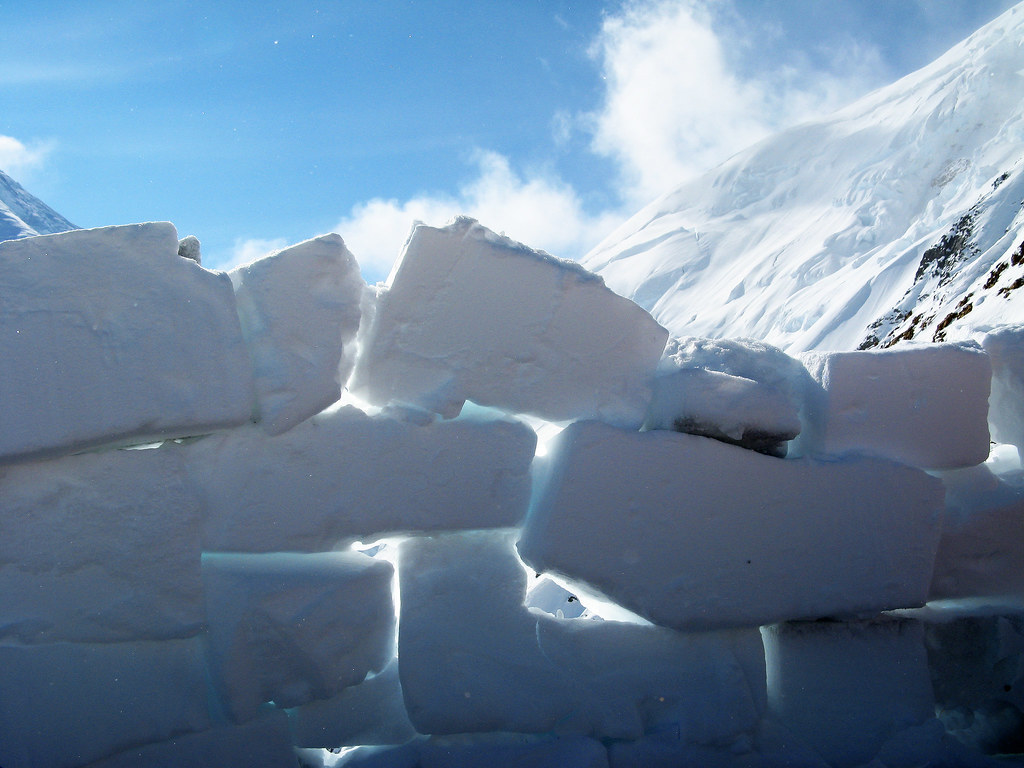
Anyway, when we reached Camp 2's narrow ridge and dug up the cached gear we'd left there the day before, we set to work building camp. Another tent platform leveling/stomping, another heavy 50-block wind wall cut from the hard, windswept snow crust all around us, and another camp set. I was positively staggering when we were done, but it was nice to only have to pitch one tent this time, and we were soon moving our sleeping gear into it.

We've just had a nice hot meal with pretty good volume this time. Nate chose mac and cheese again… awesome! I love that stuff. He also added some tasty miso soup, but I also ate half a salami and cheese bagel and an energy bar of my own to supplement.

With half our party gone, we now have an excess of group food and fuel, despite them taking a lot of the overage down with them.

Tomorrow (assuming the weather holds) we'll do a carry and cache of some group gear to the future site of Camp 3, over and beyond the Summit of Crosson, and return back to camp to to sleep. That's a day that will surely end up being more like 3000 vertical feet of climbing instead of the 1500-ish days we've been doing so far, so I need to fuel up, get my crap together, take good care of myself, and knock it down.

I feel like after lagging a bit on the rope today, I have some redeeming to do. I know I can do it, and this is what I've been training so hard for. My only concern now is that my pack still seems heavier than I want it to be every single day—and that always makes going tougher.

Topping out at Camp 2


Sunday, May 1, 2011

Foraker 2011: Sunday, May 1 – Carry to Camp 2 (Day 6)


Watch for links to video below, and click pictures for larger versions.

Morning!
Well, I tried my "brilliant" idea for a pee bottle in the middle of the night last night. I HATE pee bottles anyway because I'm always so paranoid of an accidental miscalculation that would result in me peeing in my nice, dry sleeping bag instead of the bottle. But there were no serious problems (other than my choice of bottle for this trip made the job harder than it needed to be. Ugh).

Anyway… haha uhmm… we had some light snow and some drifting in the night, but nothing significant to stop the climb. So with favorable copnditions, a plan and a goal, today began with a huge bowl of oatmeal with whole cashews and dried cranberries. Yum! And with Nate having given us an inkling yesterday of what kind of climbing lay ahead today, I wisely supplemented breakfast with an energy bar for more calories.

Today was a carry— partly a gear moving trip, partly a reconnaissance trip, and partly an acclimatization trip using the "climb high, sleep low" approach that many parties employ. Classic. The goal was to ascend to and scout a location for Camp 2 at 10,000 feet, dig a hole in the snow there, cache a bunch of food and gear in it, and then head back to Camp 1 for the rest of the day to sleep low.

We had a lot of crap to take with us, so we loaded up our packs, which consisted of a few group food bags per person, many gallon cans of fuel split between us, a couple hundred wands, some shovels, spades, and any personal gear each climber wanted to cache up higher so he didn't have to carry it tomorrow with all the rest of the tents and camp gear when we officially break Camp 1 and move up.


Into the huge snowfied above C1
 I'm (once again) annoyed with myself for having so much shit. I'm caching things in every hole we put on the mountain to save weight, but I guess this is all a necessary part of the learning process for me. Once again heavily loaded, we left camp. Joey, Craig and Kirk went first, then my rope team, in which I opted to be last after Bob. He was in the middle this time.

I knew two things in my choice: 1) that my day would be vastly easier with Bob in front of me instead of behind me because he's slow, and 2) that Nate, who might not yet be aware of the potential dangers of his fitness level yet, would get to experience first-hand having Bob behind him.

NOTE: In Bob's defense, because of the fact that he's apparently climbed with AMS many times over the years, it makes sense that they might not have applied the same intense enrollment scrutiny for this climb that I received as a brand new AMS client.


Gettin' it done.

The assumption therefore follows that AMS—knowing that Bob is now well aware of the seriousness of what he's undertaking on ANY climb with them—would trust Bob to show up ripped and fit and ready to rock, even though it's theoretically possible he could have been sitting on a couch eating nothing but Ding Dongs and soda since his last climb with them in 2004.

I know it sounds like I'm bashing poor Bob, but I'm truly not. I really grew to like Bob as a person… but liking him has nothing to do with whether he's fit enough at a given moment to be safe on a rope with others tied to him. But I digress.

As the first rope team prepared to climb, Kirk paused, saying his stomach pains had gotten worse and that he's now starting to get quite nauseated under exertion. So Joey promised to set a slow pace and see how it went, and off they went ahead of us.

The slopes we tackled today were way steeper than yesterday, even. Once above the first big snowfield above Camp 1, we climbed into large sections of scree and small talus, finding passage on dwindling patches of snow, where possible.

In some places though, the snow was thin enough over the rocks that it made being on the rocks even worse than the rocks alone, because I'd think I had solid footing on the snow, but it would break loose all the rotten rock immediately underneath it, which would throw me off balance. The scree sections in general, I found, burned a lot more energy than the snow sections, but I found a really great rhythm going up it, kicking my frontpoints into the soft earth, and drytooling it up the slope. Lots of fun.

Thankfully, once again, the sun refused to show her face for most of today, and we were blanketed on and off with low visibility clouds and fog. Joey's team was never far ahead of us today, and Bob was again a big source of slowdown for my team—which today I enjoyed thoroughly because of the slower pace. In fact, I had it pretty easy for about half the day today because of that alone. 

Spreading out up the mountain

In places, though, we were climbing so slowly that I was having difficulty staying warm… a weird problem to have while underway, since it's usually the opposite problem: how to stay cool and dry.

There's been a fast and light two-man independent team on the mountain for a few days with us now, and they've been pretty much just following our tracks, it seems like. It was honestly kind of a bummer when they pulled into Crosson base camp a few hours behind us the other day, since we were kind of expecting to have this whole route to ourselves.

Nate theorized they were only here because we'd broken trail for them across the glacier and up to Camp 1, and that they were looking for an easy summit on Crosson and possibly Foraker, with experienced, guide-laid tracks all put in for them all the way.

That way, they could waltz up to the summit and back without having to put in too much energy to the routefinding—which which seems to me to have been an accurate read of the situation. With no tracks, they might otherwise not have been here at all.

So yesterday, they climbed up just above our chosen Camp 1 spot to a bivy site at about 8,500 feet (again, probably so they didn't have to break much trail and could wait for us to pass them and put in more tracks), where they pitched for the night.

Then today, we leapfrogged past them on our way up. They said they were taking a rest day, so we waved, said hello, and plodded on past their tents. Hmm… bizarre. It would suck have these guys tagging along the whole trip.

But we climbed on. Then at about 8,900 feet, we all pulled into a break stop, where the ritual was the same as all break stops: drop your pack, put on a puffy jacket, eat a little something, drink some water, and get off your feet briefly.

Nate and Craig on break at 8,900 feet.

But this time, something was different. Kirk's condition it seems, had reached intolerable, and as we sat in a group on a rocky slope overlooking the spectacular Kahiltna glacier below, Joey announced that instead of ascending further, he'd instead be guiding Kirk back down to Camp 1, and then in the morning, all the way back across the glacier, where he would fly out back to Talkeetna to get medical attention—he's leaving.


Reminded me of Dennis the military dude who decided to leave last year's AK mountaineering course a few days in (though Kirk has a legitimate medical reason… Dennis was just a douche.) :-)

After some surprised discussion, the talk turned to how we would manage the logistics of the remaining climbers. With two people leaving, Nate's guide to climber ratio would rise to a less-than-optimal number—and we talked about other options that remained open.

Nate climbed up to the nearest ridge top to make contact with AMS and ask for advice, because apparently, a 1:1 guide ratio for (Joey and Kirk) isn't legal on the lower Kahiltna because of crevasse fall hazard.

Down to 3 climbers, and getting steeper

Left with yucky options like having a single four-man tent with four men to occupy it—tight!—or to carry a whole huge extra tent with tons of unnecessary weight, and a less than optimal 3:1 client-to-guide ratio, we talked about our new roles.

We would be an all or nothing team from that point forward, since, if someone else were injured or unable to continue, there would no longer be a second guide to stay back in camp with them or take them down while the others continued.

But Bob saved the day when he dropped another bombshell: "I'd be willing to volunteer to go down with Joey and Kirk. I mean all the way out. I feel like my pace is slowing everyone up.

Normally, I like to feel in the mountains that I can take care of myself plus one other person--and I just don't feel like I can do that right now."
 So it was agreed: Joey will take two climbers down, they'll stay Camp 1 tonight, and head down and back across the glacier to Kahiltna Base Camp tomorrow. Continuing on up the route will be a party of three: Nate, me, and Craig. Faster, lighter, and more nimble… it should be fun!

So we all swapped various rope team members, gear, and provisions, and Joey's team headed down, while Nate's team (with me on it) headed up to 10k. 

By the time we reached the spike of rock that marked the 10,000 foot precipice on Crosson's mountainside, the sun had begun to poke through a little, and a slate-grey day turned bright and glorious.


Nate, caching gear at Camp 2

An with typical Alaskan magic, it steeped the mountain ridges and peaks in fingers of wispy fog, bathed them in bright yellow sun, and the air went brisk and cold for a short while as Nate dug the hole and filled it with the gear we'd brought with us.

It had been a challenging day of climbing indeed, but I was fueled and amped for it, and I was pleased to see how energetically we all got on up the steeps required of us today.

After an inspiringly strong downclimb, Nate, Craig and I rolled back into Camp 1, but I managed to shoot some video and cool pics as we approached Camp 1 from above, with the dark silhouettes of Joey, Bob, and Kirk standing in camp as they watched our approach and descent.

Downclimbing back into Camp 1
Climbing-wise, today was a pretty neat day, and I feel great about the performance I delivered. It was everything I trained for, and more, and I knew then that I had done my preparations well.

Tonight's dinner was Thai noodles and peanut sauce… DAMN, I love this meal. It was really really good, but I don't think I had enough of it to refuel me properly for tomorrow. We'll see, I guess.


Saturday, April 30, 2011

Foraker 2011: Saturday, April 30 – Move up to Camp 1 (Day 5)

Watch for links to video below, and click pics for larger versions.

8 AM

The weather isn't perfect this morning... it's showing patchy fog and overcast skies, but we didn't get much snow in the night either, so I think we're climbing.

According to the report, it will likely be light snow on and off, which is actually good for a day like today, where really heavy packs are in the plan; cloudy skies, colder temps, and a little wind mean firmer snow and cramponing conditions—and cooler climbing.

If we were heading out today under bright sun and clear skies, we'd be baking (and later, perhaps sinking in slush), so the cold and clouds are a good thing.

9 PM 

The climb to Camp 1 was a tough one, and (according to Nate) would be our heaviest day of the trip. We went up through a steep, narrow gully of ice and rock pitched at about 50 to 55 degrees, with fully loaded packs on our backs.


Wow... quite a view of the Pizza Slice down on the glacier below Camp 1

As I feared, mine was up near 90 lbs. Ouch. I have to figure out a way to drop some weight from this thing, or it's gonna tip me over. I could barely get the damn thing on this morning, or at breaks.

The lesson, though, was definitely learned today of all days about lightness: strip everything you can. And thanks to people like Nate and Joey and Craig, with all these the lessons I'm learning (the hard way) here, I feel like next time I go anywhere, I'll be much better at packing smarter and lighter.

Upward, into the murky fog on the ridge

Interestingly, Kirk has managed to fit everything he needs into something like a 60 liter BD pack, weighing in around 45 or 50 lbs, I think... amazing. I dunno how he does it. My 115 (!!!) liter pack is LOADED.

Packing light is something of an art, and it takes discipline and practice, and Craig seems to be really good at identifying what he can strip, and choosing interesting ways of keeping things he might need, too. And he often does it with alternatives that perform the same function (or multiple functions) but are lighter.

Anyway, I was on a rope with Joey leading, me in the middle, and Bob bringing up the rear. Man, I have to say... if I was wondering about Bob's fitness and general aptitidue for this kind of climbing yesterday, today those concerns were confirmed true, in my mind. He really shouldn't be here.
 
It's dangerous for both him and us. I basically hauled him up most of the route today, yarding very hard on the rope every other step or so just to keep pace with Joey—which meant I was also carrying at least 20-40 of Bob's pounds on my chest harness with just about every step—in addition to my own ludicrously heavy load.

Keeping tension on the rope for Bob (as Joey asked me to do at the bottom of the couloir) was one thing, but Bob just wasn't moving at anything that resembled a reasonable pace, and was unsurprisingly oblivious to the rhythm that Joey--and therefore I--were trying to stick to. (Evidence of the snail-slow pace was shown later by the fact that by the time my rope team pulled into the Camp 1 site on the ridge, Nate's team had already been there for over an hour, and had most of the wind walls built. Ouch.)


The drop beneath us

Just about the entire way up the gully, Bob would take a step (maybe two), teeter precariously a bit, and then stop, looking about to collapse and barely able to breathe, and only continuing with another step or two when he felt serious tension on the rope from me—basically ignoring the movements of the rope in front of him and not keeping pace.

Yes, today was super tough for me, too, and I don't begrudge ANYONE struggling with it in places like this. Lord knows I've had my share of hard days, too. But I'm thinking that while I've trained my ass off and I'm totally ready for this kind of exertion, Bob isn't in any shape for this sort of climbing right now—or ever again at his age, if he's let himself go too far this time.

Add that he seems a little hard of hearing, and you've got a recipe for something potentially scary on steep slopes--and for getting yanked around in the middle of a rope team, with Joey moving up, and me keeping pace, but not being able to move easily without putting serious tension on the rope behind me.

I was relaying all sorts of information to him from Joey above (very loudly), but again, he acted like he was startled out of a half-sleep sometimes when you yelled his name 2, 3, or even 4 times to get him to acknowledge.

Nate and Joey climbing to fix a line in the gully yesterday
He stumbled and fell once on a steep rock section just above the main couloir that leads to the ridge (connected to me—scary). By sheer luck, I happened to be looking at him when he started to go down, so I preemptively held his fall with even more tension on the rope.

Joey was another story. Although I admit we moving slowly because of Bob, he still seemed a little impatient with even what I would consider a more reasonable pace, and seems to frequently ignore the primary mountaineering axiom of being efficient. Again, I'm no expert, but for example, he had me struggle wide out of the track at one spot into deep untracked snow to free a stuck rope from a rock, instead of just giving me an extra foot of slack to free it with a quick flick.

I get where he's coming from… slack in the rope on this kind of terrain is probably a bad thing, but I wasted a bunch of energy unnecessarily on that. Other times, his chosen line took us straight up the steep fall line instead of using what seemed to me like obvious rising traverses to keep energy level outputs more efficient.


On the ridge of Crosson at last

He was getting very impatient with me, too, while he was yelling back down the hill to me, explaining what I should do as I approached the first anchor. I can understand that it's frustrating having to explain it a couple of times to get me to understand what he meant, and to yell hard to get his voice over the wind to do it, but part of his frustration came, I think, from my apparent lack of comprehension of what he was saying.

I say "apparent" because while he was very slowly and with an annoyed tone enunciating instructions about "theeee purrrrrpllllle rooooooope!...", apparently, he didn't realize that both ropes we were connected to were quite obviously purple (though very different shades).

Now, again, I'm sure he knows things I don't about climbing in this scenario, but it made no sense to me at all. Precision, it seems to me—in language, in descriptions, in body movements, in routefinding— are all so very important in mountaineering, that it's a pervasive skill.

Since we were on two ropes, the more precise way of saying it seems to me should have been using terms like "the climbing rope" and "the fixed line" to differentiate them, instead of "the purple rope".

Me, enjoying our comfy Camp 1
That said, I guess I'm willing to accept that Joey's approach to communication on the mountain might differ from mine, and our differences might just boil down to me being a writer whose job it is every day to be extremely precise in the way I write things. But I digress.

Human frustrations aside, the bottom line is that it was a tough 2 to 3 hour climb up 50 to 55° slopes under a very, very heavy pack. (The funny part is that I only began to worry when I could barely even get the damn thing up to shoulder level in camp without nearly toppling over.)

It just felt stupid heavy, despite having trained up to 90 pounds leading up to the actual trip. Interesting how soft snow and uneven terrain will do that, even if you're accustomed to heavier stuff on smoother, firmer terrain.

Nate at Camp 1, enjoying the hard work from the day
There's no end to the workout during expedition climbs, it, seems. Once we pulled into Camp 1, I unclipped, flopped my pack on the ground, grabbed a snow saw and started cutting 2-foot square blocks of very hard snow, while Nate, Bob, Joey, and Craig hauled them over to the ridge line we were on to block the howling winds that sometimes blasts across it.

Sawing is hard work!! I was surprised just how tough it is. You wouldn't think cutting igloo blocks is all that difficult, but before long, I was sweating just as hard as if I'd just barely rolled into camp with that heavy pack still on me.

When that was done, it was onto shoveling and using spades to chop and level the bed of ice and snow on which we planned to put our tents. That process results in a lot of loose snow (especially when it's Alaska-cold out), and that, in turn, requires moving snow from the higher spots to the lower spots to level the 10' x 20' space.
 
But before we could set up the tents, all that now-loose snow requires stomping to solidify it again, so the tent floors are stable and level.

It's quite a lot of work. Then we had tents and rainflys to set up, guy out, and dig many holes to anchor them down. The work just goes on and on, but we finally started moving our crap into the tents.


Getting ready to climb back down to the cache with Nate

About that time, I was milling around getting ready to move into the tent when Nate said "Bryan, what's your energy level like?" Honestly, even after today's work, I felt totally fine and had plenty in reserve, and that's exactly what I told him, knowing what he was going to ask.

"Do you want to come with me back down the mountain a ways to pick up the cache Joey and I put in yesterday?", he asked. Me: "Sure! Just let me just get moved into the tent the rest of the way and we can head out."

The descent to the cache covered about 500 vertical feet, about a third of the total climb we did already today. We made the descent with me on lead and Nate belaying from behind, and covered the distance in about 20 min. with mostly empty packs.

Nate dug up the cache, and handed me to group food bags and a gallon of fuel, which aI loaded into my pack. After he loaded up a ton of wands and some more food bags in his pack, we headed back up to Camp 1.
 
Light snow begins to fall

Having spent time on rope with Joey earlier, it seemed like Nate kept a slightly more even pace, and I found my rhythm quickly. It was still some work, though, especially after the days exertion and over-the-top climb and camp-setting expenditure, but it was fine.

We had a great dinner—spinach and cheese tortellinis with sun dried tomatoes and ham that reminded me of prosciutto. Super tasty, and I ate a ton of it. I spent the rest of the day chilling out, resting, hydrating, and staying warm in my sleeping bag while trying not to be totally grossed out by Bob's farting.

Now that I think about it, Kirk has been pretty quiet today, but I just heard him talking to the guides about the fact that he's had stomach pains since he arrived at AMS in Talkeetna, and they've been getting worse ever since. That sucks for him.


Tiiiired... but happy and warm in bed at Camp 1


Friday, April 29, 2011

Foraker, 2011: Friday, April 29 – Crosson base camp (Day 4)

For once, the weather report was right… we got 4 to 6 inches of snow in the night, and awoke to slate gray skies, low visibility, and disappointment. I could see none of the surrounding majestic peaks.

I strained my eyes against the morning's rolling white-fog cloak to see if I could catch a glimpse of Foraker's immense and bristling bulk and its Eastern face—chock full of wicked ice falls and terrifying ridges.
 

But she seemed content to wrap herself in white and vanish before my eyes, as though she possessed mystical powers of invisibility. Damn. 
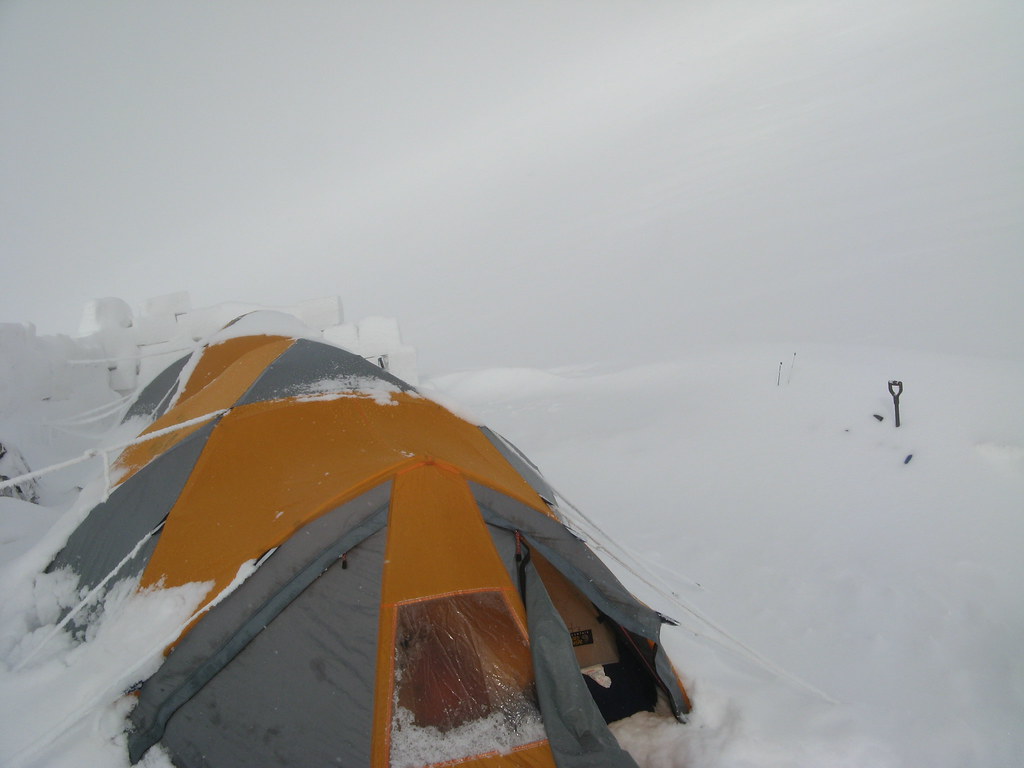
The view out the tent this morning

It seemed when I woke that today was destined to be a rest day from the get-go, and Nate confirmed it during breakfast.


He wasn't comfortable taking on the steep rock and ice gully that would get us up to Camp 1 on Crosson's ridge. And as one of the only places on the entire route that was threatened by avalanche hazard, he and Joey discussed it and decided we'd wait it out in camp today.

Bored... but happy

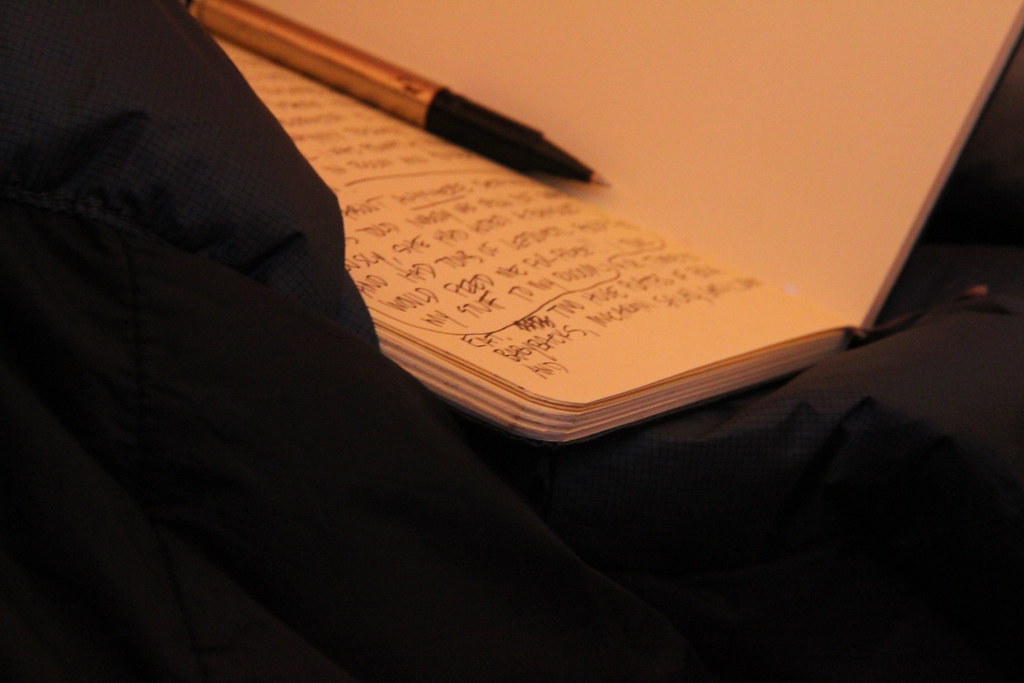
That was a good call, I think. But the decision banished us to our tents, where I spent a long and boring day, mostly writing in my journal and sleeping, punctuated by a lot of farting by Bob. Gross.


In retrospect, the two of us made quite a pair, though, since I can only start off sleeping on my left side, and apparently, he can only sleep on his right side – which put our faces just inches away from one another about half the time in the cramped tent. Good thing I brought a toothbrush. HAHA
Although I do like Bob, he nevertheless seems profoundly oblivious to most things happening around him. He's only 62, but he kinda behaves a little like someone closer to 80.

My obsession during downtime
 My dad is 84, but I noticed some of my elderly father's mannerisms in Bob: things like startling out of whatever he's doing after someone yells his name loudly the second or third time… it worries me, honestly.
I've noticed his hands shake like those of an older man, too. Seems like he really shouldn't be here, but maybe he's a stronger climber than tent mate. He and Craig have done many major peaks together including Denali, Aconcagua, I think Ixtapa in Mexico, but strangely, Bob exudes none of Craig's stamina, strength, or savvy.
I can't decide whether it's because Bob is lost his own world and completely tuned out, or because he's a little hard of hearing… maybe both. Either way, though, it seems like that's a potential safety problem on a rope.
I'm hardly an expert, as Bob has climbed far more big hills than I ever have… so he gets the benefit of the doubt from me, but we'll just have to see what happens when things get a little more vertical.
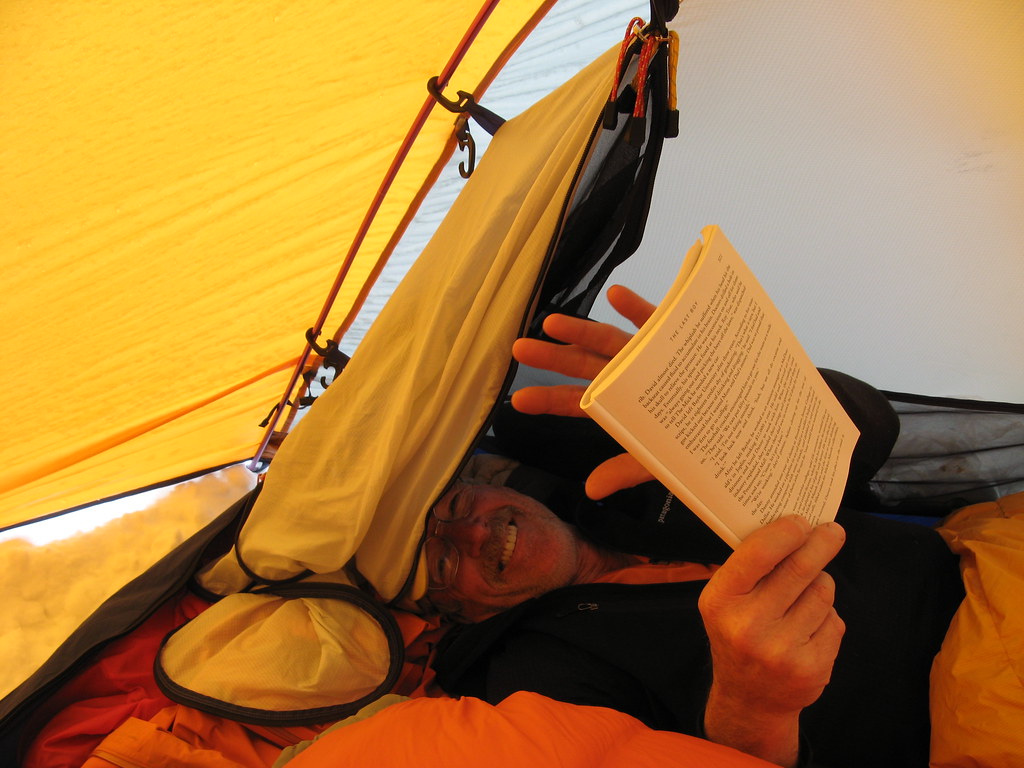
Craig, reading a book

From Craig, on the other hand, I've learned quite a lot so far, and I continue to enjoy his simultaneously genial good nature, and his gruff-and-rough personality. He's an engaging fellow to talk to, and he's full of compassion and good advice, along with many interesting stories.
Craig and Bob and the rest of a group of their close friends go back about 45 years, where they met in high school as football teammates. (Craig is the only one that went on to do anything in football. He made it to the NFL in the 70s, a golden age… which I think is pretty damn cool.)
Kirk is just as talkative as ever, and he and Joey are a constant source of entertainment with their discussions back and forth.

Looking futilely for a break in the weather
 I shot a few pictures today, and some video, but nothing too inspiring, since the whiteout lasted most of the day—which brings me to my camera situation.
For this trip, I brought two cameras: a big (but light) Canon DSLR with a light wide-angle zoom, and a backup camera – a small AA-powered Canon point-and-shoot. (My camera rig for this trip has been a key focus of my preparations, because I very much want to take the photos I shoot on this trip to a new level of quality and awesomeness.)
But a chat with Colby back at AMS has changed my thinking on it. He's an excellent mountain photographer, and a masterful climber, having done the Sultana before, and many other serious and technical routes in the Range (also having had his own epic on another aspect of Foraker some years ago), but I was still surprised to hear his suggestion: Don't take the big camera on this route.
He went on to point out the fact that although the views from the Sultana Ridge route are some of the best in the Range, the nature of the climb itself makes it not easily photographed, while still staying safe on the rope. This route, he said, "is not a photography route."
He clearly appreciated the time I'd put into engineering a camera carrying system that would allow me to shoot quickly and with one gloved hand in a variety of conditions, but nevertheless recommended I take JUST my backup camera up the mountain.

New snow in the Crosson access gully

I think he could see that I was disappointed… not because my small camera doesn't take great pictures, but because it doesn't take DSLR-quality pictures. But as we talked it over a bit more, I knew that I would heed his advice.
He took me downstairs in the AMS shop to show me the amazing set of cameras and lenses he uses as a way of saying "I'm not anti-photography, as you can plainly see…", and I appreciated that.
He then took a look at my rig and removed lots of extra batteries and stuff I wouldn't need… and then we hit on an idea that might give something of a compromise: take the big camera from Kahiltna Base Camp across the glacier to the base of Crosson and see how that feels… maybe even to Camp 1 up the gully, and then either make the decision to carry it higher, OR if it's not feeling safe, just cache it down below and pick it up on the way back. 

Some other big stuff around us on the approach into Crosson Base yesterday
Excellent advice. So yesterday's walk across the glacier was, in part, spent evaluating the efficacy of taking the big camera higher became my plan. But yesterday's "easy" work across the glacier was indeed made harder by the fact that I brought that big camera with me. It felt like a boat anchor in places.
The whole rig with bag and lens and body and batteries and backup camera was something on the order of an extra 5 lbs, and when 80 or 90 lbs is already in store, that extra 5 is a killer.
So while here at the base of Crosson, I've taken the opportunity to shoot as many pics (and HD video) as I can, because I'm afraid this is as high as it will go.

Our next leg of the journey will be with very heavy packs—as in no sleds—and everything that was in the sled will now go in the pack, too. Brutal.

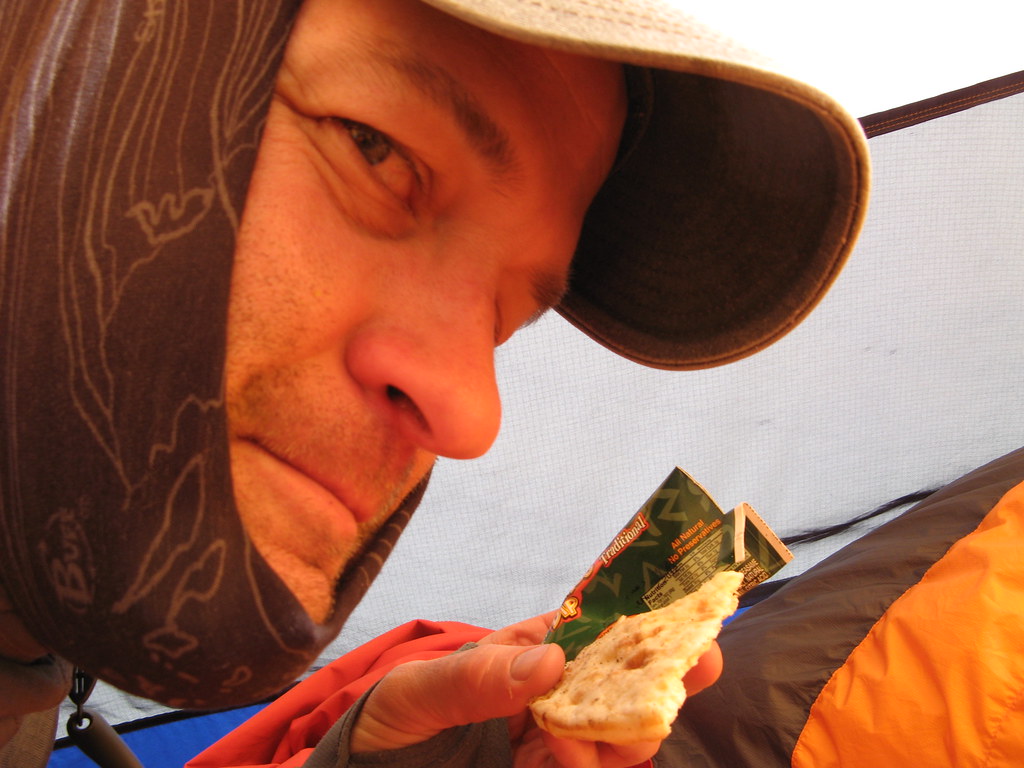
Hummus and pita bread... mmm
 Even leaving it behind, if I'm lucky enough to have a pack under 90 pounds, I'll be pleasantly surprised.

I've spent part of today trying to reach that goal, sorting out the heaviest food items and other gear I can leave behind here in a cache hole—with some helpful hints from Craig and Nate, too.
9 pm
We'll recover all the stuff we cached on the way back down, and between the big camera rig and other gear/food, I've saved myself 10 pounds or so. I'm still worried, but it's a little better. Now if only Bob would stop breathing on me, I wouldn't have to hibernate with my head inside my sleeping bag. Ugh.
Weather report came in, crackling over the radio at 8 PM, as usual. The forecast was for light snow on and off tomorrow, but with no accumulation for the next few days. They're saying we'll get a big snow on Monday, so if that all holds, we'll certainly climb tomorrow—and it'll be our heaviest pack day.
Looking forward to it… and a little worried about the pack weight. We'll see how it goes.